

New assessment tool helps insurers take a hard look at their AI game plan

In an era marked by the rapid growth of artificial intelligence in the insurance industry, a new tool has been introduced. This tool helps insurers assess their progress in AI, gain insights into how their competitors are using AI, and identify missed opportunities where AI could deliver additional benefits.
Baringa, a technology consulting firm, recently developed an AI Value and Maturity Index that assesses, among other things, the value of AI across 47 different steps in the insurance industry lifecycle.
Ryan Bohn, partner at Baringa and finance expert, said he thinks of the index as a guide insurers can use as they figure out their AI game plan.
“We use it more as a conversation starter across the industry,” Bohn said. “Think of it as an attention analysis across different parameters to be able to understand how far advanced certain firms’ capabilities are across the end-to-end value chain.”
The idea to create the index originated from a roundtable held last year by Baringa for chief financial officers in the insurance industry. During the roundtable, he said Baringa noticed AI seemed to be “a bit of an abstract discussion” rather than something more tangible and helpful for navigating this new, complex world of advanced technologies.
“What we saw at the CFO roundtable was that they are not very far, and also there’s a lack of understanding in terms of where to point it and how to use it. But there are real, real opportunities to do it across different areas of the value chain,” Bohn said.

Baringa created the index to help insurers “really just understand where the marketplace is” and also “understand relative to their peers where they are,” Bohn said.
They started by looking at the core value chain of insurance, breaking it down into 47 categories across six major areas:
- Marketing and sales — lead generation, sales outreach, referrals
- Application — document collection, quote comparisons, application intake
- Underwriting — risk assessment and pricing, underwriting decisions, final approvals
- Policy and onboarding — policy issuance, payment setup, document management
- Claims and renewals — fraud detection, claims intake, damage assessment
- Servicing and relationships — invoicing and collections, customer service, newsletters
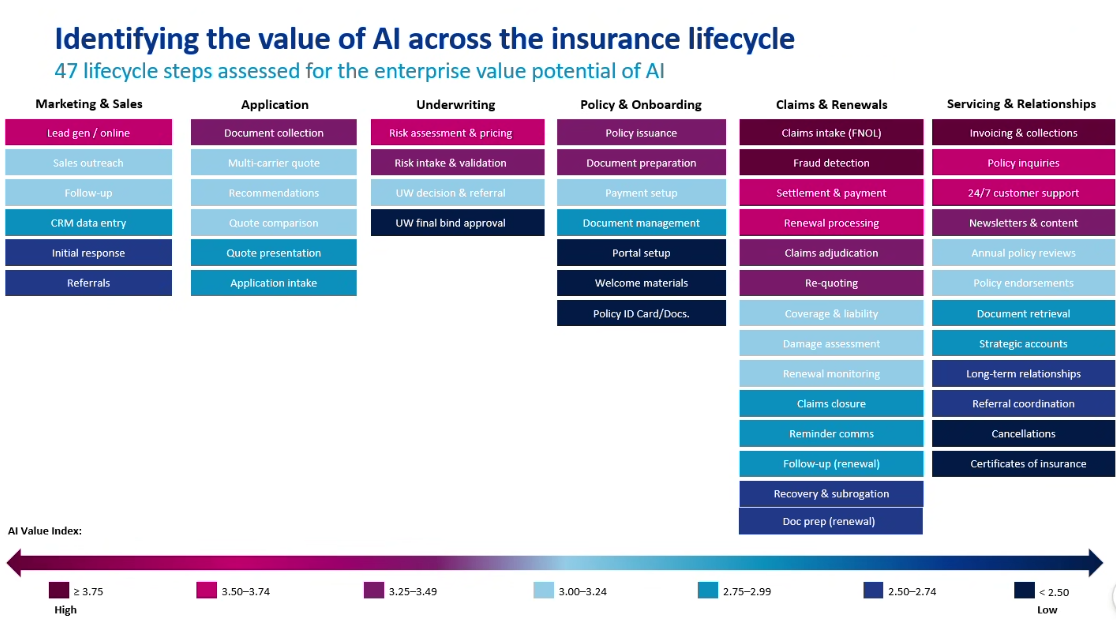
“I’m sure they’re debatable, but we’ve tried to unpack the core processes to really just understand where the industry is and where the opportunity is in the future,” Bohn said.
Opportunity and return on investment
The index assesses where most insurers are deploying AI in their practice, and where there might be untapped value in introducing AI. This can help insurers not only think about where to invest in AI, but also determine return on investment, Bohn suggested.
“The industry is seeing a lot of value on first notice loss and fraud detection, but another insurer could see a lot of benefits in document preparation and renewal, which is at the bottom and has less perceived value, but maybe others can think about other areas that they don’t have on their agenda that could be a value add,” he said.
With AI still being relatively new in the insurance space, Bohn noted that knowing where to start or finding direction can be a challenge.
“I think that that’s been the challenge; everyone has a mandate or initiative in terms of trying to implement AI across their teams, develop the strategy, but I think the challenge is if you go too wide, the value realization of that is quite challenging at times to be able to demonstrate or quantify,” he said.
At the same time, he acknowledged that costs to invest in technology can be significant, and “getting a business to substantiate a specific initiative to support” can be difficult when going in with “a blank slate.”
A guide to AI transformation
Bohn said he thinks of the AI index as a “guide” to help “break down and be specific about where AI could be deployed.”
He noted that the index’s data comes not just from trend analysis but also from Baringa’s “own research and client conversations to really help shape where the market is today, where the need is, as well as where they can point this type of technology to maximize the value.”
However, he also suggested tackling AI is “a dual approach” where insurers also must do their own legwork to determine what’s best for their respective organizations.
“I think of the index as a guide. I don’t think it’s a strategy or a playbook, first and foremost,” Bohn said. “I think this helps identify where to prioritize, but if an institution has their own legacy decisions, legacy challenges, legacy personnel — where I also think insurance is a bit antiquated from a technology perspective but also resistant to change from a personnel perspective — if you can get over the hump to be able to communicate to your teams on how this is going to make their lives better, easier, more efficient, elevate the role, that is where I think this can help firms engage their own teams, own stakeholders, to create those use cases or proofs of concepts to really move the needle on what they do day-in and day-out.”
© Entire contents copyright 2026 by InsuranceNewsNet.com Inc. All rights reserved. No part of this article may be reprinted without the expressed written consent from InsuranceNewsNet.com.
The post New assessment tool helps insurers take a hard look at their AI game plan appeared first on Insurance News | InsuranceNewsNet.