
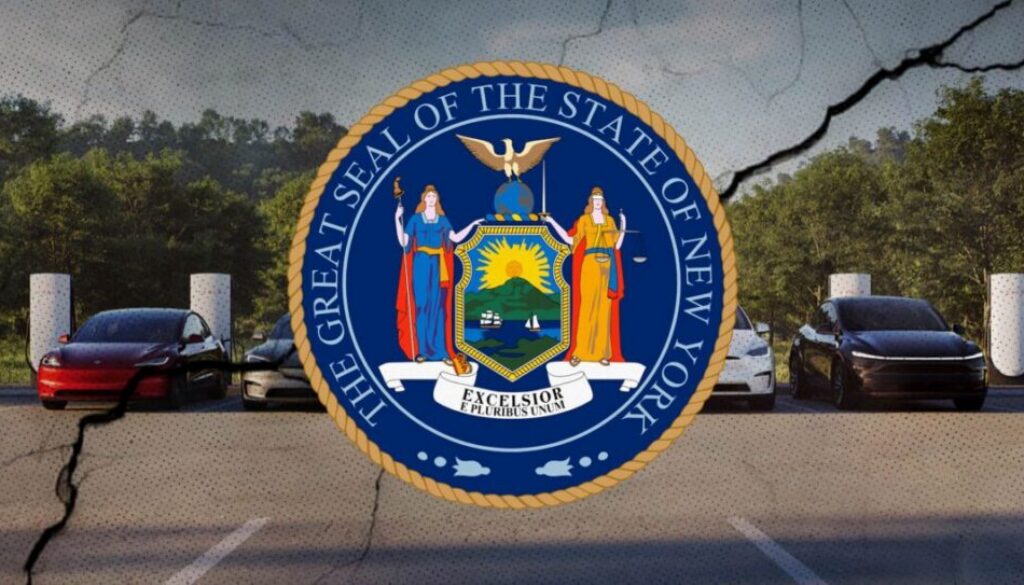
Tesla Insurance blocked as NY regulators examine connected-car coverage

Tesla’s effort to launch a new personal auto insurance program in New York hit a regulatory roadblock recently after state officials rejected the proposal.
The New York Department of Financial Services rejected a filing from Tesla General Insurance Inc. that would have limited eligibility to Tesla vehicles identified through vehicle identification numbers, or VINs.
Regulators raised concerns under Section 2324 of New York Insurance Law before reviewing the filing’s actuarial merits, according to an analysis from S&P Global Market Intelligence.
The filing comes as Tesla continues expanding an insurance business that has grown rapidly in recent years.
Tesla’s insurance entities generated $644.2 million in direct written premiums during the first half of 2026. California accounted for $477.8 million of that total, followed by Texas at $60.4 million, Nevada at $23.3 million and Maryland at $15 million.
New York produced no direct written premium during the period despite Tesla Insurance Co. being licensed in the state, according to S&P.

Tesla’s insurance operation was originally established to help address insurance affordability and availability challenges facing Tesla owners, according to Tim Zawacki, head of financial institutions research at S&P Global Market Intelligence.
“Its purpose is not to be a competitive source of insurance coverage for a broad segment of the market,” Zawacki said. “It’s to essentially eliminate a point of friction in the Tesla sales process.”
Tesla pushes deeper into insurance
Tesla launched its insurance business with a model that incorporates driving data collected from Tesla vehicles.
The company has increasingly shifted business into Tesla-affiliated insurance companies and away from outside carriers.
Zawacki said that strategy emerged partly because some insurers were reluctant to write electric-vehicle business or charged higher premiums because of repair costs and loss severity associated with EV claims.
Previous research from S&P Global Market Intelligence found Tesla generated $1.37 billion in direct written premiums during 2025, up 40.7% from $970.8 million a year earlier. Tesla-affiliated insurers wrote 75.9% of Tesla’s insurance business directly in 2025, compared with 32.6% in 2024.
California remained Tesla’s largest insurance market and represented nearly 70% of premium volume during 2025. Premium volume in the state climbed to $725 million, according to S&P.
Tesla also expanded insurance availability into additional states while taking on more underwriting risk itself.
Previous reporting based on S&P data found Tesla’s insurance operations reported roughly $182.7 million in underwriting losses during 2025 and an overall direct loss ratio of 100.4%.
Regulators focus on eligibility
The New York filing centered on eligibility requirements rather than insurance pricing.
The proposed program would have limited participation to Tesla vehicles through VIN-based eligibility.
S&P said regulators viewed that structure as raising concerns under New York’s anti-tie-in provisions and addressed the issue before reviewing other aspects of the filing.
The filing arrived in a state that has previously expressed support for telematics and usage-based insurance, creating an unusual situation in which regulators objected to the structure of the program rather than the underlying technology.
“Their efforts to establish a program in New York, for example, have been thwarted by state regulation, which does not permit a company to underwrite only one manufacturer’s vehicles,” Zawacki said.
In guidance issued to insurers, the NYDFS said telematics can improve underwriting decisions, align premiums more closely with risk and encourage safer driving behavior. The department also encouraged insurers to submit telematics and usage-based insurance programs.
According to the National Association of Insurance Commissioners (NAIC), usage-based insurance programs can incorporate information such as mileage, acceleration, braking patterns and driving times when evaluating risk and setting premiums.
Safety Score draws attention
The filing also involved Tesla’s Safety Score model.
Tesla says Safety Score evaluates driving behavior using information collected from Tesla vehicles and estimates the likelihood of a future collision. The company says the model is built using billions of miles of driving data collected from its fleet.
In states where Tesla’s Real-Time Insurance product is available, Tesla says Safety Score can affect monthly premiums. The company also says the program relies on vehicle-generated data rather than plug-in devices or separate hardware.
S&P reported regulators denied Tesla’s request for confidential treatment of documentation related to the model.
While Tesla frequently highlights the scale of its driving-data collection, Zawacki said the practical underwriting value of that information can vary depending on state regulations.
“It’s not particularly meaningful,” he said of the advantage in California, noting that restrictions limit how telematics data can be used in the underwriting process.
The review comes as New York lawmakers and regulators continue examining telematics programs and data-driven insurance models.
Recent proposals have focused on transparency requirements, consumer access to telematics information and oversight of models used in insurance pricing.
Automakers expand insurance offerings
Tesla is not the only automaker incorporating vehicle data into insurance products.
General Motors Insurance uses connected-vehicle technology to help personalize rates and allows customers to insure non-GM vehicles under the same policy.
GM says the program uses technology already built into connected vehicles rather than requiring additional devices.
That differs from Tesla’s proposed New York program, which would have limited eligibility to Tesla vehicles.
Zawacki said Tesla’s approach remains unusual among U.S. automakers, most of which have relied on partnerships and referral arrangements with established insurers rather than building insurance operations of their own.
“There really aren’t any parallels, I don’t think, for what Tesla’s structure is like in the U.S. market,” he said.
The NAIC has identified connected-car technology as a growing part of usage-based insurance programs as insurers and automakers gain access to larger volumes of driving and vehicle data.
© Entire contents copyright 2026 by InsuranceNewsNet.com Inc. All rights reserved. No part of this article may be reprinted without the expressed written consent from InsuranceNewsNet.com.
The post Tesla Insurance blocked as NY regulators examine connected-car coverage appeared first on Insurance News | InsuranceNewsNet.