
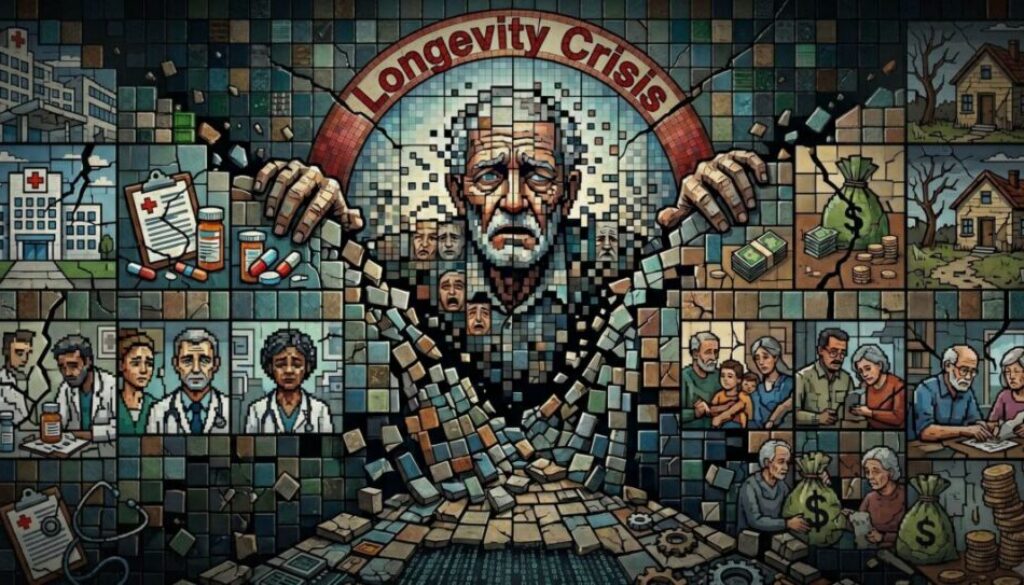
Living longer, retiring poorer: Why systems, not savvy, failing Americans

The growing mismatch between how long Americans are living today and how financially prepared they are could be due to fragmented systems more than financial literacy, according to Chris Moran, head of market strategy and partnerships, Savvi Financial.
In an interview with Insurance News Net, Moran noted that people are now living around 10 to 15 years longer than before, but many still “haven’t figured out how to support those extra years” from a financial standpoint.
“For a long time, the financial services business has viewed this as an education problem,” Moran said. “There’s a lot of talk about financial literacy or an individual behavior problem, meaning people aren’t disciplined enough to do it. We see a lot of investment in education to help solve the behavior problem, yet we’re still seeing a great deal of financial stress.”
At the same time, he said life is more complex now than it used to be as people are “dealing with rising healthcare costs, uncertainty around Social Security, market volatility, debt and all these things are somewhat fragmented.”
However, he suggested artificial intelligence can help coordinate financial planning across siloed systems and deliver personalized advice at scale.
“This was impossible 20 years ago, but I think where we are today, in the age of AI, access is becoming better. With where the analytics and decision science is today, we’re in a much better spot,” he said.

Financial advisors play a key role in helping clients tap into this.
“My personal opinion is that the role of financial professionals is going to become more important, not less,” Moran said. “I don’t see technology replacing them… We really see the role of advisor becoming less portfolio manager and more like a financial systems architect where they’re really going to help households build this structure that’s going to allow them to maintain a quality lifestyle both while they’re working and also into retirement.”
‘Longevity alone is not the issue’
In Moran’s view, longer lifespans on their own are a big part of the longevity crisis equation. But, “the bigger challenge” is that financial responsibility has been shifted entirely onto the individual without significant improvements to existing systems or coordination of systems needed to support those financial decisions.
“You think back 30, 40 years ago, your parents worked 30, 40 years, they got a pension,” he noted. “They got healthcare and they had an enjoyable retirement. Now, a lot of responsibility is on the employee, but we really haven’t given them the tools to navigate those.”
Further, many of those decisions are “made in silos,” where a benefit decision is made at open enrollment, retirement decisions are made throughout the year, and other financial decisions are made in tandem with bi-weekly paychecks.
“We really see it as a system design problem, meaning the system wasn’t designed to deliver the better outcome for the employee,” Moran said. “The employee experiences one financial life, yet we ask them to make these decisions around products and also where they make the decisions fragmented.”.
Connecting the dots
Helping people coordinate decisions across the different financial aspects of their life will be key to solving the issue, alongside education and personalized guidance, Moran suggested.
“I think this is where it’s not necessarily more product — we always used to try to say there’s a new silver bullet product out there that’ll solve it. But what we really believe is more being able to connect the systems,” he said.
This is an area Savvi expects to see “a lot of advancements” in over the next two to three years to help solve the problem of coordinated financial decisionmaking, Moran said.
“I think there’s more work for us to do to align, from insurance carriers to brokers, to employers, to record keepers, payroll providers and benefit platforms, to serve the employee better and deliver better outcomes for those employees,” Moran acknowledged.
For instance, he said the financial services industry “really needs to do a better job of helping the employee understand what their risks are.”
“Employees tend to plan for a stable income and stable health. But the reality is, life isn’t stable,” he noted. “You’re going to lose your job at some point. You’re going to have a health event at some point, and is your financial system going to be able to withstand that? We want to be able to help people measure that risk, and then really get people into a much more durable position.”
The good news, Moran added, is AI can help enable and scale that effort “easily.”
“Where a human advisor could only work with 50, 100 households, they were limited,” Moran said. “But because of technology, we can reach millions of households with this. The best part is, people are going to be able to access the quality decisions, and that’s really what’s going to change things for the industry overall. That, I’m excited about.”
© Entire contents copyright 2026 by InsuranceNewsNet.com Inc. All rights reserved. No part of this article may be reprinted without the expressed written consent from InsuranceNewsNet.com.
The post Living longer, retiring poorer: Why systems, not savvy, failing Americans appeared first on Insurance News | InsuranceNewsNet.