
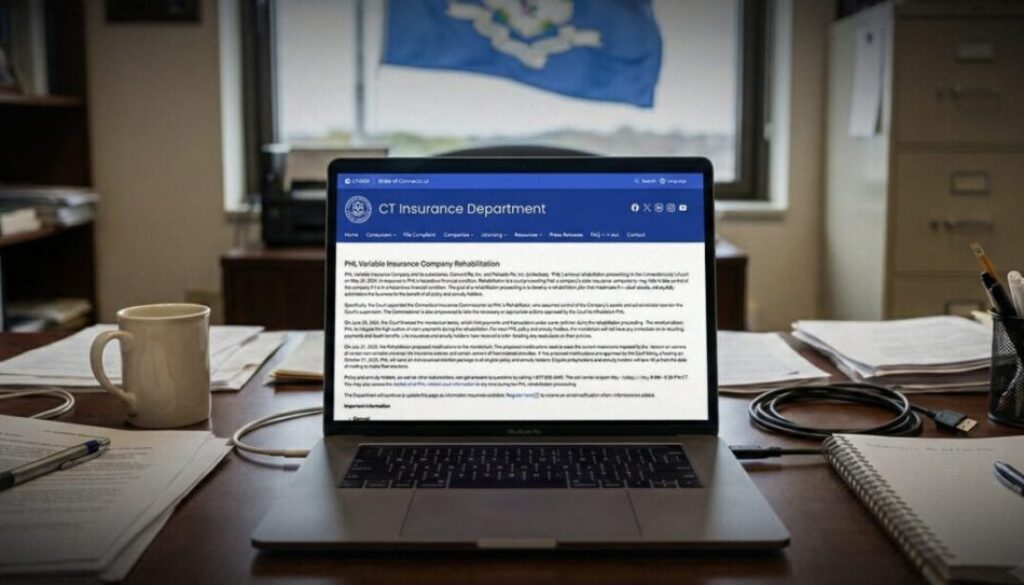
State to decide on potential buyer for PHL Variable policies by Dec. 31

Several companies are competing to take over or reinsure all or parts of the troubled PHL Variable Insurance Co. business, and the Connecticut Department of Insurance said it will decide which proposal to pursue by the end of 2025.
Five companies submitted proposals of interest: three whole company proposals and two partial company bids. In addition, one party not previously engaged submitted an initial indication of interest proposing a whole company transaction, said Insurance Commissioner Andrew Mais in his Nov. 20 status report filed with the Connecticut Superior Court.
Mais abruptly announced his retirement after filing the report. Nov. 28 was his final day. Gov. Ned Lamont tapped Josh Hershman, a former deputy commissioner at the CID, to succeed Mais.
Earlier this year, Mais announced the effort to sell all or parts of the PHL Variable business. The sales effort is a crucial part of a delayed overall rehabilitation plan for PHL Variable. In the Nov. 20 status report, Mais said the rehabilitator also “expects to file an outline of the terms of a rehabilitation plan” by the end of the year.
It is unclear whether Mais’s departure will impact the rehabilitation plan timeline. A request from InsuranceNewsNet for clarification did not receive a response from CID in time for deadline.
The troubled PHL and its subsidiaries, Concord Re and Palisado Re, were put in Mais’s control after a May 20, 2024, court order.

Lawsuit on the table
The status update provided several other newsworthy notes on the PHL rehab effort. Efforts continue to recoup losses to third parties, Mais wrote, without further elaborating on the nature of those losses or the types of third parties involved.
“If an acceptable resolution that would be in the best interests of policyholders cannot be achieved, the Rehabilitator intends to file a lawsuit against such parties,” the status update said.
Otherwise, PHL’s Investment Committee continues to explore scuttling some of the companies’ “more complex, structured, and riskier assets, including alternative assets, collateralized loan obligations, asset-backed securities, commercial mortgage-backed securities and other real estate-backed assets.”
That is part of an ongoing effort to reposition the PHL companies’ portfolio into “cash, short-term investments and high-quality, short-duration bonds,” Mais wrote.
The PHL companies’ cash, cash equivalents, and short-term investments increased from $170 million on Dec. 31, 2024, to $437.5 million as of Sept. 30, 2025 (including $89.9 million in reinsurer-specific segregated accounts), the status report said.
As part of his rehabilitation effort, Mais introduced the moratorium on benefits payments until a Connecticut court approves a final plan. Rehabilitators allowed for “hardship” appeals and Mais provided an update on those results as well.
As of Nov. 12, roughly 460 applications were received under the hardship program. About 185 of those applications received deficiency notices requiring the submission of further information; 83 were resolved, 101 are awaiting supplemental documentation from the applicant and one is under review by the hardship committee.
Mais authorized 310 payments totaling approximately $8.8 million. There were 28 denials and 11 appeals. Thirteen of the denials were “technical denials,” or instances in which applicants were seeking benefits that were already being paid or were not available under the policy even in the absence of the moratorium, the status report said.
Three of the appeals resulted in a hardship payment; three are pending receipt of additional information from the applicant; and one is currently pending review by the hardship committee.
PHL Variable surrenders stabilized
Mais noted that surrenders stabilized during the first nine months of 2025. Surrenders and withdrawals were a concern throughout 2024, with rehabilitators recording $401.1 million worth during the year.
Total surrenders and withdrawals amounted to $130.3 million through the end of the third quarter 2025, Mais reported. Nearly half of the surrender and withdrawal activity related to variable annuity products, with another 37% relating to recurring annuity payments and distributions under fixed indexed annuity products permitted under the moratorium, he noted.
Regulators and policyholders await a decision by Judge Daniel J. Klau on a proposed modification of the moratorium on access to PHL Variable benefits. The rehabilitator received 66 informal comments and 26 formal comments on the proposed modifications, Mais reported.
Mais previously explained how policyholders can access more of their benefits. Universal life policyholders have two options under the moratorium modification:
- Reduction in the face amount of death benefits with downward premium adjustment prospectively.
- Convert policy to a claim for a fixed amount (to be determined based on adjusted surrender value) with no ongoing premium obligation.
The modification is expected to offer fixed indexed annuity owners who have not activated their income rider or are currently receiving systematic withdrawals two alternatives:
- Activate the income rider (to the extent available under the contract).
- Receive a one-time surrender-charge free distribution of the “Free Withdrawal Amount” under the contract (typically this is approximately 10% of the contract’s account value).
© Entire contents copyright 2025 by InsuranceNewsNet.com Inc. All rights reserved. No part of this article may be reprinted without the expressed written consent from InsuranceNewsNet.com.
The post State to decide on potential buyer for PHL Variable policies by Dec. 31 appeared first on Insurance News | InsuranceNewsNet.