Pacific Life, Nationwide, and Prudential made big moves up the life insurance new premium charts during the first quarter, LIMRA reported Wednesday.
Overall, individual life insurance new annualized premium improved 8% year over year to $3.94 billion in the first quarter, according to LIMRA’s U.S. Life Insurance Sales Survey, which represents 80% of the U.S. life insurance market.
The total number of policies sold increased 1% in the first quarter of 2025, compared with the prior year’s results.
The new premium was not distributed evenly, however. Pacific Life made one of the biggest moves, with a 38% year-over-year increase in new premium to take over the top spot. PacLife finished 2024 in third place for the year.
Likewise, Nationwide (up 47%) and Prudential (up 25%) saw big year-over-year increases during the first quarter. Northwestern Mutual, which finished the first quarter 2024 and the full year 2024 as the leader in life premium, slipped to second in Q1 with a year-over-year decrease of 4%.
Economic conditions are driving increasing interest in the stability and flexibility of life insurance, said John Carroll, senior vice president, head of Life and Annuities, LIMRA and LOMA.
“Retail life insurance premium growth, driven by indexed and variable universal life product sales, was extremely strong in the first quarter. Persistent inflation and higher equity market volatility drove interest in permanent life insurance,” he said. “Amid the increased availability of capital through private equity investment and reinsurance, coupled with advanced technologies and product innovation, LIMRA predicts continued growth for the life insurance industry in 2025.”
LIMRA provided a breakdown of new premium by life insurance category:
Indexed universal life
In the first quarter of 2025, indexed universal life increased 11% to $959 million. About 75% of IUL carriers reported gains in the first quarter with half experiencing double-digit growth. The number of policies sold jumped 7% in the first quarter, with the majority of carriers posting positive growth. IUL premium represented 24% of overall new annualized premium in the first quarter.
“Carriers reporting the strongest sales growth cited an elevated demand for high face amount solutions as well as expanding middle-market success, fueled by new or more competitive products, simplified sales solutions and expanded distribution,” said Karen Terry, corporate vice president and head of LIMRA Insurance Product Research. “Although our research shows consumers’ concerns about the economy has spiked in recent months, LIMRA is forecasting IUL sales to experience moderate growth in 2025.”
Variable universal life
Variable universal life new premium surged 41% year-over-year in the first quarter to $533 million. Seven in ten VUL carriers reported double- or triple-digit sales growth. Policy count rose 6% in the quarter, compared with first quarter 2024. VUL premium held 14% of the total U.S. life insurance market in the first quarter.
Whole life
Whole life new premium totaled $1.48 billion in the first quarter, slightly above results from first quarter 2024. The number of whole life policies sold inched up 2% in the first quarter, compared with first quarter of 2024, due to an increase in final expense/small policy sales. Whole life insurance new premium held 37% of the total new annualized premium sold in the first quarter.
Term life
Term new premium slipped 1% in the first quarter to $738 million, with more than half of carriers reporting declines. Policy count fell 2% in the quarter. In the first quarter, term new annualized premium held 19% market share of the U.S. individual life insurance market.
“The very consumers who are most affected by heightened inflation and increased economic uncertainty — often middle-income and younger adults — are the target market for term products,” Terry said. “Historically, weaker economic conditions and recessions often depress sales of these products.”
Fixed universal life
Fixed universal life new premium dropped 4% to $235 million. This is the lowest quarterly premium collected for the product line since third quarter of 2023. Although accumulation-focused products and fixed hybrid life/long-term care insurance products posted growth, overall premium growth fell because of lower current assumption and lifetime guarantee sales.
The number of fixed UL policies sold tumbled 13% from first quarter 2024 results. Fixed UL premium represented 6% of the total new annualized premium in the first quarter.
For more details on the sales results, go to First Quarter 2025 U.S. Life Insurance Industry Estimates in LIMRA’s Fact Tank.
The sweeping federal budget legislation dubbed the “big, beautiful bill” by its backers is sparking sharp debate over its potential impact. While the insurance and investment management sectors were spared direct hits in some areas, major changes to Medicaid and ACA subsidies could ripple through the broader financial ecosystem—and eventually touch retirement and wealth planning professionals.
The bill sidesteps significant changes to retirement products, annuities, or the way financial advisors do business. But a closer examination shows the effects could be more far-reaching—especially for health insurers, hospitals, and even wealth advisors who may see a shift in client behavior.
“Interestingly enough, the version of the bill that narrowly escaped out from the House of Representatives does not have any major implications for the retirement planning or annuity industries,” said Ryan Brown, head of annuity sales and general counsel at M&O Marketing in Southfield, Michigan. “The lack of adding such provisions is likely the result of other congressional committees focusing and raising awareness of the positives surrounding annuities within employee-based contribution plans like 401(k).”
Indeed, there is no new fiduciary rule or fee disclosure requirement tucked in the language, and provisions from the earlier SECURE Act expansions were untouched. That is a relief for some advisors who had braced for more aggressive regulatory changes in the wake of growing scrutiny over indexed products and fiduciary standards.
Proposed estate planning changes
But Brown did point to a significant estate planning change: “The bill does propose to make the existing federal estate tax thresholding permanent and then raise the estate tax exemption to $15 million (single) and $30 million (joint), indexed for inflation starting in 2026.”
That would be a welcome shift for high-net-worth individuals and advisors focused on legacy planning. Still, it is a narrow slice of the market, unlikely to shift day-to-day advisor workflows.
BBB’s ACA, Medicaid impacts
Where the bill gets more complicated—and controversial—is in its healthcare provisions.
The legislation rolls back enhanced subsidies under the Affordable Care Act and tightens Medicaid eligibility rules in ways critics say could trigger a wave of insurance loss, especially among younger, lower-income Americans.
Current estimates are about 13.7 million more uninsured Americans by 2034 than there would have been without the bill. – Yehuda Tropper, CEO of Beca Life Settlements
“The bill’s significant changes to Medicaid and the ACA marketplace are projected to make health insurance much less affordable for many Americans,” said Yehuda Tropper, CEO of Beca Life Settlements. “This would likely push them out of the health insurance system and increase the financial burden on hospitals for uncompensated care. Current estimates are about 13.7 million more uninsured Americans by 2034 than there would have been without the bill.”
For insurers, the reduction in subsidized enrollees means fewer premiums and greater uncertainty in risk pools. For health systems, it may result in higher costs for treating patients without coverage. But for investment advisors and asset managers, the link is less direct—though not absent.
Tropper said the fallout could spur growing interest in alternative asset classes—particularly life settlements, a niche investment where institutional buyers purchase life insurance policies from seniors who no longer need or can afford them.
Possible ‘increased interest in life settlements’
“Investment advisors may see increased interest in life settlements as an alternative asset class, especially if traditional investments like stocks and bonds are affected by larger changes to the economy because of the bill,” he said. “For some, life settlement portfolios can be seen as a hedge against market downturns because their performance is not correlated with the stock or bond markets.”
That message is resonating more in recent months as economic indicators point to slower growth, volatile markets, and stubborn inflation. Life settlements, while illiquid and complex, offer steady, long-term returns that are not tied to the whims of the Fed or global markets.
Still, the bill’s impact may be overstated—or at least, uneven. For all the rhetoric surrounding it, the legislation leaves many in the investment and insurance community untouched in the near term. The changes to Medicaid and ACA subsidies are real and potentially troubling, especially for millions who may lose coverage.
But for most financial advisors, the day-to-day effect may be limited—unless the broader economic implications begin to alter consumer behavior. In that case, the ripple effects could be large. Fewer insured Americans may lead to greater out-of-pocket healthcare costs, increased reliance on savings, and a reevaluation of long-term care and life insurance needs. Advisors may need to pivot accordingly—not because of direct regulation, but due to shifting client priorities in an increasingly unstable safety net.
Senate weighing several changes to bill
And in an election year, few are betting that the current version is the last word.
The Senate is already weighing several proposals that could add new dimensions to the industry’s regulatory landscape.
Among them is a controversial provision requiring work requirements for Medicaid recipients and rolling back enhanced ACA subsidies—changes that could increase the number of uninsured Americans and raise costs for providers and insurers alike.
The Senate is also considering expansions to Health Savings Accounts (HSAs), including broader eligibility and higher contribution limits, which could create new planning opportunities for advisors and insurers.
Meanwhile, bipartisan legislation introduced by Sens. Elizabeth Warren and Josh Hawley would force health insurers that own pharmacy benefit managers to divest from their pharmacy operations—an effort to rein in conflicts of interest and drug pricing.
At the state level, bills like New York’s “Insure Our Communities Act” and California’s consumer data protection legislation point to a patchwork of regulatory shifts ahead. Together, these developments underscore that while the “big, beautiful bill” may be the headline, the real changes could unfold in the months to come.
Defendants are asking a California court to dismiss a lawsuit alleging a tax-avoidance scam around Penn Mutual whole life insurance policies.
A group of 29 plaintiffs claim that Penn Mutual Life Insurance Co. and several co-defendants ran a tax-avoidance scam around whole life insurance policies.
In March, plaintiffs filed a complaint in U.S. District Court for the Central District of California, alleging fraud and negligence, as well as violations of the Racketeer Influenced and Corrupt Organizations Act (RICO).
Plaintiffs come from states around the country and ask the court for $23.5 million in damages.
“Unbeknownst to the Plaintiffs, these tax avoidance and related scams were a sham and their purported tax advantages illusory and/or illegal,” write attorneys from the Los Angeles firm, Holmes, Athey, Cowan & Mermelstein.
Plaintiffs describe a coordinated sales system in which Penn Mutual whole life policies were aggressively marketed as offering “significant tax advantages.”
The lawsuit alleges that Penn Mutual teamed with advisor Randall Scott Boll, and several other law, lending, accounting and financial planning firms also named as defendants. Together, they constituted a “High-Premium Insurance Enterprise,” plaintiffs claim.
Boll pleaded guilty to one count of conspiracy to cause a financial institution to fail to file currency transaction reports and to structure financial transactions. He was sentenced to one day behind bars in California, court records say, and two years of supervised release.
‘Would not be enough’
Most of the defendants filed motions to dismiss in recent days. Plaintiffs fail in their bid to establish a RICO claim, reads the motion filed by Wintrust Life Finance. Wintrust claims to be “the largest traditional life insurance premium finance lender in North America,” with more than $5.9 billion in outstanding loans.
A 1970 federal law, the RICO statute was created to thwart criminal enterprises, specifically mob bosses. Wintrust attorneys say plaintiffs are overreaching by claiming a criminal enterprise.
“Even if one accepts Plaintiffs’ conclusory allegation that Wintrust knew Boll misrepresented the tax benefits to Plaintiffs, this still would not be enough to allege that Wintrust (and all other identified defendants) shared a common purpose to defraud the Plaintiffs,” the motion states.
In its motion to dismiss, Penn Mutual attorneys say plaintiffs “falsely inflated their net worths on their policy applications to circumvent Penn Mutual’s underwriting standards.”
Plaintiffs allege that “Boll and other members and associates of the enterprise would reap high commissions (as much as 75-125% of the initial annual premium paid by the policyholder) for each HPI policy sold.”
One type of “sham tax avoidance strategy” incorporated premium financing life insurance loans to finance the policies, the lawsuit alleges.
“The HPI Enterprise Defendants took advantage of plaintiffs’ lack of sophistication and convinced them that such policies were affordable due to the tax deductions they would generate—in essence promising them that the HPI policies would pay for themselves,” the lawsuit says.
Premium financing claims
Using life insurance in a premium financing strategy to manage tax obligations remains a controversial tactic within the industry.
Penn Mutual attorneys say the company provided multiple warnings and disclosures on how premium financing works and the risks involved.
“Notwithstanding the warnings and disclosures, Plaintiffs went forward with their policy purchases in connection with the premium financing and tax strategies they were allegedly trying to execute on Boll’s advice,” their motion reads. “They now claim that, after circumventing the safeguards that Penn Mutual had in place to avoid such issues, they are left with unaffordable policies, premium financing loans and, apparently, failed tax strategies.”
The volume and speed of regulatory changes under the Trump administration is keeping insurers on their toes and reshaping what risk management looks like in 2025, according to one industry expert.
“Overall, I would say both the speed and volume of regulatory changes is greatly impacting the industry… Not only do insurers have to understand the impact directly to the company itself, but they also have to understand the impact to the sectors that they insure,” Peter Dugas, executive director, Capco, and managing director of the company’s Center of Regulatory Intelligence, said.
As an example, Dugas pointed to the May 12 executive order directing U.S. pharmaceutical companies to lower drug prices. As a result, he said, health insurers have to rethink the way they price, underwrite or effectively deliver certain health insurance products.
“They’re having to respond to not only the president’s actions itself and the impact to the insurer, but then also to the actual sector that is either providing a product or services or delivering something to the consumer,” Dugas said.
High frequency of regulatory changes
President Donald Trump issued over 140 executive orders in his first 100 days in office during this term, a historically high amount. That number now stands at 152, and a series of tariffs have also been introduced that have impacted insurance claim costs.
Dugas noted this frequency of regulatory changes dramatically differs from previous administrations, including Trump’s previous administration.
“While there were a lot of activities that were taking place regarding laws or regulations or modifications to policies, this is really happening on a daily basis or even an hourly basis. That is something that really has changed, so the ability for insurance companies to be responsive to that speed and that volume of change is particularly important,” Dugas said.
Increased monitoring needed
According to Dugas, the frequent regulatory changes mean insurers must now keep their eyes on not only the Department of Insurance but also:
Departments of commerce, transportation and state
U.S. Trade Representative Office
The Office of the Governor
State attorney generals
State legislatures — especially those opposing the president’s stance on areas such as climate change, ESG or DEI
Any number of agencies that are either implementing, withdrawing or amending rules and regulations that directly impact insurers and the industries they insure
“Because of the speed at which the president and his agenda is moving, it’s causing a challenge for financial institutions because not only are they having to monitor the traditional areas that they would monitor for, whether it’s tax or trade, they’re also having to increase the scope of coverage at the state level,” Dugas noted.
He said this is necessary to “assess potential direct impacts to either the cost of insurance, the underwriting of insurance or the approach they take to products or services they deliver in the marketplace.”
Geopolitical risks becoming standard
Dugas suggested the global impact of President Trump’s regulatory changes and tariffs mean geopolitical risks are increasingly becoming table stakes for U.S. insurers.
“Geopolitical risk management is now becoming just an imperative. Most companies don’t have the luxury of avoiding the overall risk to their industry by the actions taken either by the Trump administration or by foreign governments in response to actions taken by the Trump administration,” he said.
For instance, retaliatory tariffs or other retaliatory actions could cause supply chain challenges or introduce foreign labor restrictions or export controls. Dugas stressed that insurers must understand these new risks and how they could impact the products or services they offer.
“We’re starting to hear more insurance companies starting to formalize their geopolitical risk management program in order to better integrate intelligence into the process so they can either assess emerging risk, real-time risk or just overall risk to the sectors that they are underwriting or covering. Because of that, they’re having to look at things like de-risking,” he said.
Liquidity concerns
Additionally, Dugas said real-time assessment of the potential impact regulations and tariffs have on cost is creating new liquidity challenges for insurers.
“When it comes to liquidity overall, I think most insurance companies — and most industries, not just insurance companies, in general — were really caught off guard by the broad applicability of the tariffs. So, trying to be able to build out models that would allow for an insurance company to understand real-time variability and the pricing of those models could potentially cause liquidity challenges that they will then need to have to price in and respond to,” he said.
He noted that insurers not only need real-time assessment of expected impact on cost, but also need to understand potential tax implications that could result from states trying to respond to federal changes.
“There’s also areas related directly to policy. So, it could be everything from how the states are having to respond to things like artificial intelligence and how they associate the risk with products or services delivered to the marketplace,” Dugas said.
Capco, a Wipro company founded in 1998 and based in London, UK, is a technology and management consultancy firm that specializes in the financial services industry. It has more than 1,500 consultants across over 30 offices around the world.
The life insurance industry has been “going digital” for many years. But despite the occasional breakthrough, the digital transition is evolving at a snail’s pace.
Legacy systems remain a very large hurdle for many old-guard life insurance companies.
“So many carriers still host their policy management on legacy systems,” said Jake Littman, senior analyst, life & annuity research for Corporate Insight. “Many are outdated and are built to support a more rudimentary user experience with only the most basic capabilities.”
Littman was joined on the panel by Brian Weber, assistant vice president of marketing communications for Kuvare. It’s not just that legacy systems are older, Weber said.
“There’s a lot more, let’s just say, data architecture, that goes into a change that might seem simple, [but] actually has a lot more implications over the broader scope of systems,” he explained.
LIMRA research shows steadily rising interest from younger adults, particularly Gen Z and Millennials, for researching and purchasing life insurance online compared to traditional methods. In 2023, for the first time, consumers reported preferring online purchasing over in-person meetings.
Products can be complicated
At the same time information technicians worked to develop digital delivery of products, product development folks were creating more complex products. Like registered index-linked annuities, which first appeared in 2010 but did not take off for several years.
“Life insurance and annuities are complicated products a lot of the time, and many key decisions should be made under the advice of an advisor or an agent,” Littman noted. “Looking into the future, we hope that some of that advice can become digital.”
Marrying digital delivery to more complex products seems like a two steps forward, one step back process at times. Some processes seem averse to digitization. Variable annuities, for example, require important subaccount decisions.
“If you have any kind of variable annuity or variable universal life account, subaccount allocation is really, really important,” Littman said. “Getting through a digital process like this, it’s not hard to get to the end. But there are really consequential decisions that are baked into this process that probably require some kind of guidance.”
Even converting basic beneficiary management information to digital is proving to be challenging for many insurers. Many insurers do not venture beyond basic information and instructions.
Policyholders wanting to know what happens when a beneficiary dies, or when there are multiple beneficiaries, are often out of luck.
“Oftentimes, customers are left to their own devices to try to figure this stuff out or seek guidance on their own,” Littman said.
Likewise, the industry has a significant problem notifying beneficiaries that they are listed on policies, he added. Since launching its policyholder locator tool in November 2016, the National Association of Insurance Commissioners has helped connect consumers with over $10 billion in unclaimed benefits from life insurance policies and annuities.
Digital could help, but Ladder Life Insurance Co. is the rare company that offers an email notification to anyone listed as a beneficiary on a life policy, Littman said.
Chatbot support
Most life insurers are using chatbots to provide at least some level of communication and policy support. These AI-powered tools assist with tasks such as policy inquiries, billing, claims processing, and customer onboarding.
Globally, the insurance chatbot market is experiencing significant growth, projected to expand from approximately $736.8 million in 2024 to over $5.2 billion by 2033, according to Dimension Market Research.
The results vary greatly, the panel said.
Chatbots cannot do much for policy management in the life insurance and annuity space, Littman explained, and are more deeply ingrained for the business of health insurance, bank and credit card customers.
“When it comes to life insurers, the chatbots are incredibly basic,” Littman said. “They often can’t even answer the most basic questions about what products the carrier offers or what the firm’s financial strength ratings are.”
Life insurers are certain to continue experimenting and expanding their integration of AI and other digital tools. But they should do so cautiously, Littman said, remembering who they are serving.
“There’s a lot that can be made digital, but we really have to think about more comprehensively, about what the policyholder really needs to have the outcomes that they’re looking for,” he said, “and not just try to make it so everything gets thrown on the policyholder digital experience, because that’s not good for anybody.”
Despite rumblings of widespread dissatisfaction, UnitedHealth Group shareholders voted to support a $60 million stock package for returning CEO Stephen Hemsley Monday morning.
The 24-minute shareholder meeting touched briefly on the recent upheaval that saw UHG part abruptly with CEO Andrew Witty and abandon its earnings outlook delivered less than four weeks earlier.
Hemsley sought to calm investor fears with confident comments on a return to profitability. He declined, however, to put a timetable on UHG’s turnaround, instead pointing to July 29 as the date for a new earnings outlook. UHG will report second-quarter results at that time.
UnitedHealth will cut costs and factor in the higher cost of care into its private insurance plans and Medicare Advantage plans, Hemsley said.
“I’m introducing new initiatives to include a comprehensive review of all our policies, practices, and the associated processes and performance measures for risk assessment, for managed care practices, and for pharmacy services,” he said. “We will use authoritative, independent experts to evaluate and assess these reviews, and will modify our approaches where appropriate.”
Hemsley, who returned to the CEO chair following Witty’s May 12 resignation, will receive a base annual salary of $1 million and $60 million in UHG stock options on a three-year contract.
The ISS proxy alert states that recent fluctuations in stock price could create a “windfall” for Hemsley. UHG sent a letter to shareholders urging them to support the executive pay proposal.
“[I]n reality, all shareholders would gain from increases in the company’s stock price relative to current levels,” wrote Christopher R. Zaetta, executive vice president, chief legal officer and corporate secretary.
The shareholder vote, commonly referred to as a “Say-on-Pay” vote, is not binding on the board.
The UHG letter notes that Hemsley’s overall compensation level is designed to encourage fulfillment of the three-year contract and is in the “median” range for large-company CEOs. And if Hemsley, 72, resigns or is terminated by UHG “for cause,” he will “forfeit the [stock] options in their entirety.”
“Hemsley himself currently holds a significant portion of his net worth in our shares,” the letter states. On May 16, “he purchased more than $25 million of our shares on the open market with his own funds, further signaling his commitment to and stake in building long-term shareholder value.”
Glass Lewis, another prominent proxy advisory firm, has recommended shareholders vote “For” the compensation structure, the UHG letter says.
Unexpected cost drivers
During its April Q1 earnings call, UHG Chief Financial Officer John Rex outlined “three buckets” its higher costs fall into:
A greater-than-expected impact on United Healthcare from the health status of new members.
Further acceleration of utilization within Medicare Advantage.
Finally, “indications of a broadening of this higher trend to other areas.” In response to a question, Rex said the higher utilization of services is being seen in patients “with complex medical conditions” and is mainly “in the outpatient and physician side.”
Hemsley, who led UHG from 2006 to 2017, emphasized the discipline he is bringing back, along with “a fresh perspective.”
“Clearly, we have gotten things wrong. We underestimated care activity and cost trends,” Hemsley said. “We are intensively examining our approaches and have already begun to make improvements, including, most notably, a significant retooling of our efforts to ensure more precise and more accurate forecasting of both care and financial activity.”
UHG received one shareholder proposal to limit “excessive golden parachutes” for departing executives. It was voted down by shareholders.
Amid concerns about artificial intelligence “replacing” humans as usage increases, a recent labor study found most insurance companies plan to increase staff hiring over the next year.
The 2025 Insurance Labor Market Study released by insurance recruitment specialists Jacobson Group and Ward, the performance benchmarking division within Aon’s Strategy and Technology Group, found 55% of American insurance companies plan to hire more staff over the next 12 months, primarily in life/health insurance (60%). The largest growth is projected to be in technology, underwriting and claims.
According to Jeff Rieder, partner and head of benchmarking, Aon STG, the statistics indicate that human talent still reigns supreme in insurance despite investments in technology.
“The key theme, from my perspective, is that that individual, face-to-face consumer interaction that financial advisors provide is going to remain critical… At this point, we’d still say that AI, in terms of replacing individuals completely, is still pretty far down the path,” Rieder said.
Projected growth and hiring
According to the study, most insurers are looking to hire due to an expected increase in business volume (33%) or planned expansion of business or new markets (34%). Seventy-four percent of companies expect to grow revenue over the next 12 months, rather than reduce staff due to AI job losses.
Rieder explained that there was “kind of a rush of hiring” in the 2021-2022 cycle as companies anticipated more growth than was actually experienced. Now, in a “post-pandemic” environment, he said there has been a mixed approach to hiring as insurers are also reacting to the resulting fallout and inflationary markets.
“When we’re seeing some of those roles that are being hired for now, companies are still trying to actively grow, which is why we’re seeing some of the areas that are hiring. Sales and marketing for the life and health area, life and annuity writers in particular, still remains very heavy,” he said.
Automation and redundancy
The study also found 12% of American insurance companies plan to reduce staff over the next 12 months, marking an increase from 10% in the previous year.
This is mostly due to business restructuring (10%), rather than AI job losses. However, automation improvement requiring fewer staff and areas currently overstaffed are tied close behind at 9%, followed by contraction of business operations/discontinuing operations at 7%.
Rieder acknowledged that many insurance companies are investing heavily in technology at the moment, including AI and the technology experts who can develop and maintain those systems.
“When you look at roles — particularly in underwriting, which was the No. 1 area across our life and annuity companies, followed by technology — we’re seeing heavy investments in core system replacements in the life sector right now. Companies are investing heavily in updating or replacing those technologies, but that also includes advancements in predictive modeling, predictive analytics, artificial intelligence, and really enhancing their digital strategy,” he said.
Humans in the loop
Despite the heavy investments in technology and some redundancies related to automation, Rieder said a strong need for human talent prevails.
“What was interesting for the life sector is underwriting was actually the No. 1 function that was expected to increase over the next 12 months. I think what that indicates is that while many of the underwriting processes are being streamlined and automated, the need for that true underwriter in that individual that understands risk and can apply that to each company’s appetite is very much still in high demand,” he said.
He added that while tech hiring was No. 1 overall, that result was more influenced by P&C carriers while it was a No. 2 function on the life/health/annuities side.
“There’s so much complexity with all these new technologies, new systems, that people still need to have that person-to-person interaction to understand their own individual risks that they have or their investment needs. That financial advisor is still going to be crucial to a very, very large population, despite all the investments that are being made in technology and analytics. So, we’ll still see that phrase ‘human in the loop,’ even around all these technological changes,” Rieder said.
No evidence of AI job losses
Further, Rieder suggested there is no evidence indicating advisors will lose jobs for not being an expert in AI.
“I don’t know if there’s any empirical data. Anecdotally, we know that individuals are able to work faster by using AI. But I don’t know if I’ve seen anything empirically that does an analysis between those who are adept versus those who are not,” he said.
However, he noted that it does benefit advisors to know how to use AI and understand how it’s being incorporated into business decisions.
“There’s so much volatility and complexity in the world today, whether we’re talking tariffs, inflation or global uncertainty, that I would say the financial advisor is still critical to that overall relationship because they can help individuals navigate these really complex issues better than any type of technology or artificial intelligence can at this point,” Rieder said.
The Jacobson Group is an insurance talent recruiting firm founded in 1971 and based out of Chicago, IL.
Aon is a British-American company that offers professional services and solutions. It was founded in 1982 in Chicago, IL, and now has nearly 70,000 employees in 120 countries. Aon’s Strategy and Technology Group provides insurance insights and software.
Regulators are set to adopt an asset adequacy testing guideline to add another layer of transparency to major reinsurance deals.
The Life Actuarial Task Force (LATF), comprised of National Association of Insurance Commissioners members, worked for about 18 months to create the guideline. That work included many concessions to insurance industry groups.
The resulting guideline is limited in scope, agreed Fred Andersen of the Minnesota Department of Commerce, and disclosure-only. It will be voted on by LATF at its June 5 meeting.
“There are U.S. reinsurers that will be impacted. It’s not just offshore reinsurers,” Andersen said. “There have been over a trillion dollars of recent reinsurance transactions on the life and annuity side. It’s become apparent that working together across jurisdictions is vital to help ensure death benefits and annuity payments are paid to U.S. policyholders.”
The effort is seen as regulators seek to get a handle on a life insurance industry that has become more financially complex. Once private equity firms took an ownership interest in life insurers, offshore reinsurance deals boomed.
U.S. life insurers have nearly doubled their ceded reserves since 2019, increasing from $710 billion to $1.3 trillion in 2023, Fitch Ratings noted in a recent report. During the same period, reserves ceded to offshore jurisdictions nearly quadrupled, exceeding $450 billion.
Product-level analysis
LATF members have acquiesced to industry on several points throughout the guideline development. However, members drew the line on Thursday on language that would give them the option to require a “product-level analysis” after 2025.
“When we receive cash flow testing filings, we’re used to seeing the life insurance [and] annuity analysis done separately,” Andersen explained. “They tend to have different risks. They have different types of assets backing them, so on and so forth.”
In recognition of the work already required by the asset testing guideline, LATF opted not to include the product-specific analysis for the initial year 2025. LATF’s timeline calls for the guideline to be adopted and the first reinsurance asset testing reports due on April 1, 2026.
Brian Bayerle, chief life actuary for the American Council of Life Insurers, balked at the inclusion of product-level analysis.
“We are concerned that over time, it’s going to create even more work for companies that, at least from our perspective, we don’t see how that will provide value to regulators,” he said, “particularly for the level of effort required to do this activity for some companies.”
Bayerle suggested that regulators could revisit the idea for a deeper analysis with companies in the future. None of the regulators liked that idea.
“I just don’t like the idea that states should have to follow up for the information we’re trying to get by casting this net in the first place,” said Joshua Blakey of the Oregon Division of Financial Regulation.
Under $100 million
Which reinsurance treaties will be covered by the guideline also generated extensive discussion during Thursday’s 90-minute LATF meeting. The task force voted to exclude reinsurance treaties under $100 million in reserve credit.
Andersen found that companies he is most concerned about – newer entrants aggressively selling annuities, for example – are all “well above” the $100 million barrier.
“When I listed the treaties that I thought would be in the scope, none of them are under $100 million, so I don’t think this will actually have any impact,” he said.
The initial proposal to tighten the reins on reinsurers was made in February 2024 by David Wolf, acting assistant commissioner for the New Jersey Department of Banking and Insurance, and Kevin Clark, chief accounting and reinsurance specialist with the Iowa Insurance Division.
Standard asset adequacy analysis requires reserves to be held at a level that meets “moderately adverse conditions, or approximately one standard deviation beyond expected results,” the Wolf/Clark proposal noted.
“When a reinsurance transaction lowers the ceding insurer’s reserves, the new reserves established by the reinsurer could be materially less than what would be needed to meet policyholder obligations under moderately adverse conditions in addition to providing an appropriate level of capital,” the proposal continued.
Annuity sales might have peaked, judging by the still-strong first-quarter sales data released Friday by Wink, Inc.
Total Q1 sales for all annuities were $98.2 billion, according to Wink’s Sales and Market Report, down 1.9% compared to the previous quarter and down 5.7% compared to the same period last year. All annuities include the multi-year guaranteed, traditional fixed, indexed, structured, variable, immediate income, and deferred income annuity product lines.
Noteworthy highlights for all annuity sales in the first quarter include Athene USA ranking as the No. 1 carrier overall for annuity sales, with a market share of 9.7%. New York Life came in second place, while Equitable Financial, Corebridge Financial, and Allianz Life completed the top five carriers in the market, respectively.
Courtesy of Wink. Inc.
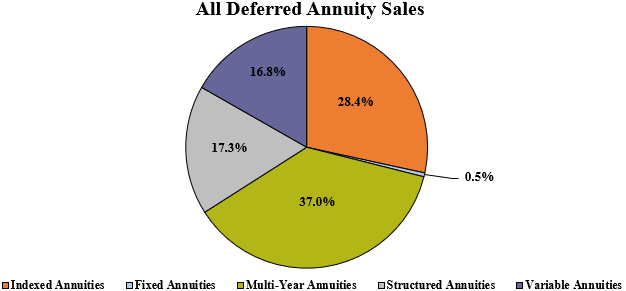
Total first-quarter sales for all deferred annuities were $95 billion, down 1.6% when compared to the previous quarter and down 5.4% compared to the same period last year. All deferred annuities include the multi-year guaranteed annuity, traditional fixed, indexed annuity, structured annuity, and variable annuity product lines.
Noteworthy highlights for all deferred annuity sales in the first quarter include Athene USA ranking as the No. 1 carrier overall for deferred annuity sales, with a market share of 10%. New York Life moved into the second-ranked position, while Equitable Financial, Corebridge Financial, and Allianz Life, completed the top five carriers in the market, respectively.
Equitable’s Structured Capital Strategies Plus 21, a structured annuity, was the No. 1 selling deferred annuity, for all channels combined, in overall sales for the second consecutive quarter.
Courtesy of Wink, Inc.
Total first quarter non-variable deferred annuity sales were $62.7 billion, up 1.7% when compared to the previous quarter and down 14.6% when compared to the same period last year. Non-variable deferred annuities include the MYG annuity, traditional fixed annuity, and indexed annuity product lines.
Noteworthy highlights for non-variable deferred annuity sales in the first quarter include Athene USA ranking as the No. 1 carrier overall for non-variable deferred annuity sales, with a market share of 14.6%. New York Life took the second-ranked position, while Corebridge Financial, Sammons Financial Companies, and Global Atlantic Financial Group completed the top five carriers in the market, respectively.
Athene Annuity’s Athene MYG 5 with MVA, a MYG annuity, was the No. 1 selling non-variable deferred annuity for the quarter, for all channels combined, in overall sales for the quarter.
Courtesy of Wink, Inc.
Total first quarter variable deferred annuity sales were $32.3 billion, down 7.7% when compared to the previous quarter and up 19.3% when compared to the same period last year. Variable deferred annuities include structured annuity and variable annuity product lines.
Noteworthy highlights for variable deferred annuity sales in the first quarter include Equitable Financial ranking as the No. 1 carrier overall for variable deferred annuity sales, with a market share of 17%. Jackson National Life continued in the second-place position, as Lincoln National Life, Prudential, and Allianz Life completed the top five carriers in the market, respectively.
Equitable’s Structured Capital Strategies Plus 21, a structured annuity, was the No. 1 selling variable deferred annuity, for all channels combined, in overall sales for the fourth consecutive quarter.
Courtesy of Wink, Inc.
Total first quarter income annuity sales were $3.1 billion, down 10.3% when compared to the previous quarter and down 13.2% compared to the same period last year. Income annuities include immediate income annuity (SPIA) and deferred income annuity (DIA) product lines.
Noteworthy highlights for income annuity sales in the first quarter include New York Life ranking as the No. 1 carrier overall for income annuity sales, with a market share of 43.7%. Western-Southern Life Assurance Company continued in the second-ranked position, as Massachusetts Mutual Life Companies, Nationwide, and Penn Mutual completed the top five carriers in the market, respectively.
Courtesy of Wink, Inc.
Multi-year guaranteed annuity sales in the first quarter were $35.2 billion, up 20.8% when compared to the previous quarter, and down 19.5% compared to the same period, last year. MYGAs have a fixed rate that is guaranteed for more than one year.
Noteworthy highlights for MYGAs in the first quarter include Athene USA ranking as the No. 1 seller, with a market share of 16.3%. New York Life moved into the second-ranked position, while Corebridge Financial, Pacific Life Companies, and Global Atlantic Financial Group concluded as the top five carriers in the market, respectively.
Athene Annuity’s Athene MYG 5 with MVA product was the No. 1 selling multi-year guaranteed annuity, for all channels combined, for the quarter.
Sheryl Moore, CEO of both Wink, Inc., and Moore Market Intelligence, said, “It is unusual to see sales increase from the fourth quarter to the first quarter of the next year. Apparently, someone should have given the memo to the insurers offering MYGAs.”
Courtesy of Wink, Inc.
Traditional fixed annuity sales in the first quarter were $496.5 million, up 1% when compared to the previous quarter, and down 9.1% compared with the same period last year. Traditional fixed annuities have a fixed rate that is guaranteed for one year only.
Noteworthy highlights for traditional fixed annuities in the first quarter include Global Atlantic Financial Group ranking as the No. 1 seller, with a market share of 14.2%. Nationwide ranked second, while Modern Woodmen of America, National Life Group, and CNO Companies concluded as the top five carriers in the market, respectively.
Forethought Life’s ForeCare Fixed Annuity was the No. 1 selling fixed annuity, for all channels combined, for the nineteenth consecutive quarter.
Courtesy of Wink, Inc.
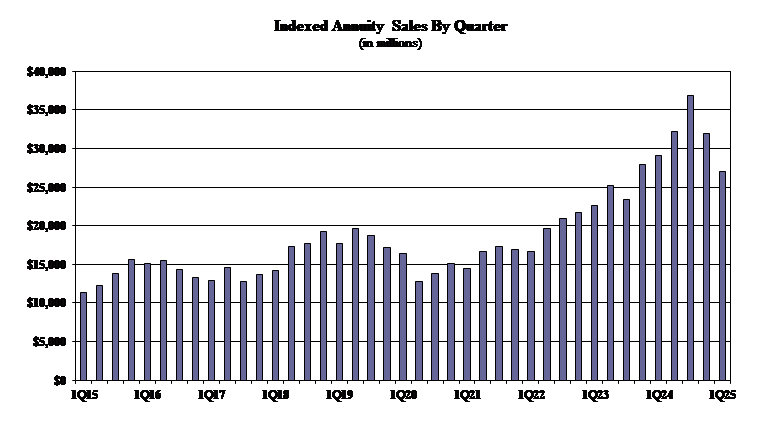
Indexed annuity sales for the first quarter were $27 billion, down 15.6% when compared to the previous quarter, and down 7.2% compared with the same period last year. Indexed annuities have a floor of no less than 0% and limited excess interest that is determined by the performance of an external index, such as Standard and Poor’s 500.
Noteworthy highlights for indexed annuities in the first quarter include Athene USA ranking as the No. 1 seller, with a market share of 12.6%. Sammons Financial Companies ranked second, while Allianz Life, Corebridge Financial, and American Equity Companies completed the top five carriers in the market, respectively. American Equity’s IncomeShield 10 was the No. 1 selling indexed annuity, for all channels combined, for the second consecutive quarter.
Courtesy of Wink, Inc.
Structured annuity sales in the first quarter were $16.4 billion, down 4.7% compared to the previous quarter, and up 17.7% compared to the same period last year. Structured annuities have a limited negative floor and limited excess interest that is determined by the performance of an external index or subaccounts.
Noteworthy highlights for structured annuities in the first quarter include Equitable Financial ranking as the No. 1 seller, with a market share of 21.5%. Allianz Life ranked second, while Prudential, Brighthouse Financial, and Lincoln National Life completed the top five carriers in the market, respectively. Equitable’s Structured Capital Strategies Plus 21 was the No. 1 selling structured annuity, for all channels combined, for the fourth consecutive quarter.
“While structured annuities have been around for more than a decade, we are still seeing new entrants regularly,” Moore said. “It is amazing how the sales trajectory has mirrored that of indexed annuities.”
Courtesy of Wink, Inc.
Variable annuity sales in the first quarter were $15.9 billion, down 10.5% compared to the previous quarter, and up 21.1% compared to the same period last year. Variable annuities have no floor, and the potential for gains/losses is determined by the performance of subaccounts that may be invested in an external index, stocks, bonds, commodities, or other investments.
Noteworthy highlights for variable annuities in the first quarter include Jackson National Life ranking as the No. 1 seller, with a market share of 16.7%. Equitable Financial ranked second, while Lincoln National Life, New York Life, and Nationwide finished as the top five carriers in the market, respectively.
Jackson National’s Perspective II Flexible Premium Variable & Fixed Deferred Annuity was the No. 1 selling variable annuity for the twenty-fourth consecutive quarter, for all channels combined.
“While variable annuity sales are up over this time last year, I wouldn’t be expecting that trend to continue with the recent volatility in the markets,” explained Moore.
Courtesy of Wink, Inc.
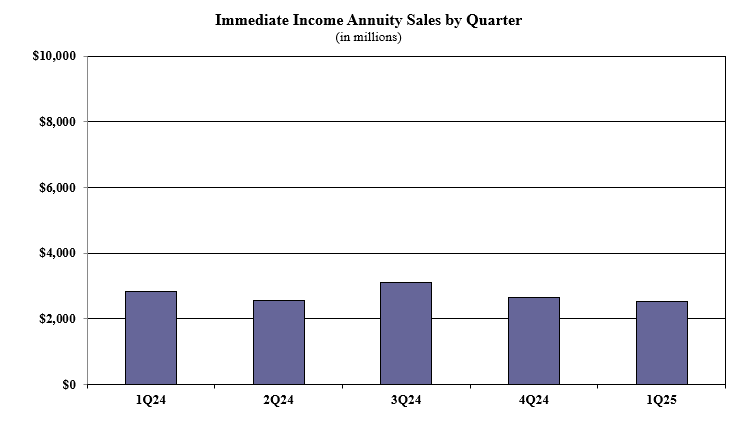
Immediate income annuity sales in the first quarter were $2.5 billion, down 4.6% as compared to the previous quarter and down 11.4% as compared to the same period last year.
Noteworthy highlights for SPIAs in the first quarter include New York Life ranking as the No. 1 seller, with a market share of 43.2%. Massachusetts Mutual Life Companies ranked second, while Nationwide, Western-Southern Life Assurance Company, and Penn Mutual finished as the top five carriers in the market, respectively.
Courtesy of Wink, Inc.
Deferred income annuity sales in the first quarter were $672 million, down 26.7% compared to the previous quarter and down 19% compared to the same period last year.
Noteworthy highlights for DIAs in the first quarter include New York Life ranking as the No. 1 seller, with a market share of 45.8%. Western-Southern Life Assurance Company ranked second, as Massachusetts Mutual Life Companies, Integrity Life Companies, and Global Atlantic Financial Group finished as the top five carriers in the market, respectively.
Courtesy of Wink, Inc.
Wink now reports sales on all annuity lines of business, as well as all life insurance product lines, Moore noted in a news release.
Most Americans believe that to gain long-term financial security, seeking professional financial advice early between the ages of 25 and 39 is “highly important” or “critical.” This is one of the findings from Northwestern Mutual’s 2025 Planning & Progress Study, which explores Americans’ attitudes, behaviors, and perspectives on issues that impact their long-term financial security.
So, why is it important to seek advice early in life? According to James Munder, wealth management advisor at Northwestern Mutual’s Munder Financial, Gen Z and millennials are navigating a vastly different world, compared to their parents. The costs of attending college, buying a home, and raising a family have all increased, resulting in a smaller margin for mistakes among young people. “This situation creates financial stress, and gaining knowledge and understanding is the best way to address uncertainty,” Munder said. “Consulting a financial expert can help alleviate their financial worries and guide them toward enhanced financial stability.”
Why are younger consumers seeking guidance?
Many individuals in Gen Z have ambitious plans to retire earlier and are acting on these plans by beginning their retirement savings 15 years earlier than Baby Boomers did, said Munder, in explaining the decision of younger adults to seek financial guidance. “They’re also being exposed to the financial world in ways that previous generations weren’t. Platforms like FinTok – the financial advice side of TikTok – along with trends such as meme stocks and cryptocurrencies, have sparked their interest, providing financial advisors with opportunities to discuss more reliable investment and wealth management strategies.”
Additionally, Munder said, many companies have automated retirement savings programs, encouraging young people to start saving earlier and more consistently. Some younger Americans are also more interested in socially responsible and sustainable investing. “Financial advisors can guide them in aligning their investment strategies with their values, making financial planning more meaningful and personalized,” he added.
The impact of receiving advice early
There are several benefits to receiving professional financial advice early. For example, Munder said, starting early makes it significantly easier to accumulate long-term wealth because of compound interest. For instance, he said, someone who invested $100,000 in the S&P 500 in 2010 would have nearly $700,000 by the end of 2024. “This really showcases the substantial wealth that can be built by investing early and sticking with it.”
It’s important to remember, though, that financial security involves more than just growing wealth; it’s also about protecting it, Munder added.
“Just like in a game of football, having a strong offense and defense will increase your chance of success. So, what does that defense look like in the financial world? Purchasing insurance earlier in life, for instance, can result in better rates because younger individuals are generally healthier. It’s crucial to consider that unexpected events, like a long-term illness, injury, or worse, could occur at any time. Having life and disability insurance can help lay the groundwork for financial stability in the future.”
Additionally, a financial advisor can help millennials and Gen Z uncover potential blind spots and develop a comprehensive plan that can help serve as a roadmap to guide someone towards lifelong financial security. “Early financial planning can empower individuals to achieve life goals. such as buying a home, starting a business, or funding education for their children. Moreover, professional advice can help them better manage debt and optimize their tax situations, potentially leading to more effective wealth accumulation and preservation,” Munder said.
Challenges in advising younger consumers
Financial professionals sometimes face obstacles when offering financial advice to younger Americans. As Munder explained, many young adults are unaware of the affordability of insurance products when purchased earlier in life. Additionally, some don’t realize that they don’t need substantial wealth to consult a financial advisor. As an advisor with many young professionals and young families as clients, the key is to first establish a relationship, Munder said.
“Get to know your potential clients, ask insightful questions, understand their aspirations and concerns, and then discuss strategies to help them enjoy the present while planning for the future. Educating younger clients about the long-term benefits of financial planning and demystifying financial jargon can also make these services more appealing and accessible,” he said.
Meanwhile, according to the survey, adults said they trust financial advisors more than any other source for financial advice by a wide margin. For example, one-third of Americans trust financial advisors the most – nearly double the #2 source of advice (family members) and triple the #3 source (spouse/partner). Gen Z stands out slightly as the only generation to identify family members as the most trusted source of financial advice, followed closely by financial advisors.
The 2025 Planning & Progress Study was conducted by The Harris Poll on behalf of Northwestern Mutual among 4,626 U.S. adults aged 18 or older. The survey was conducted online between January 2 and January 19, 2025.