
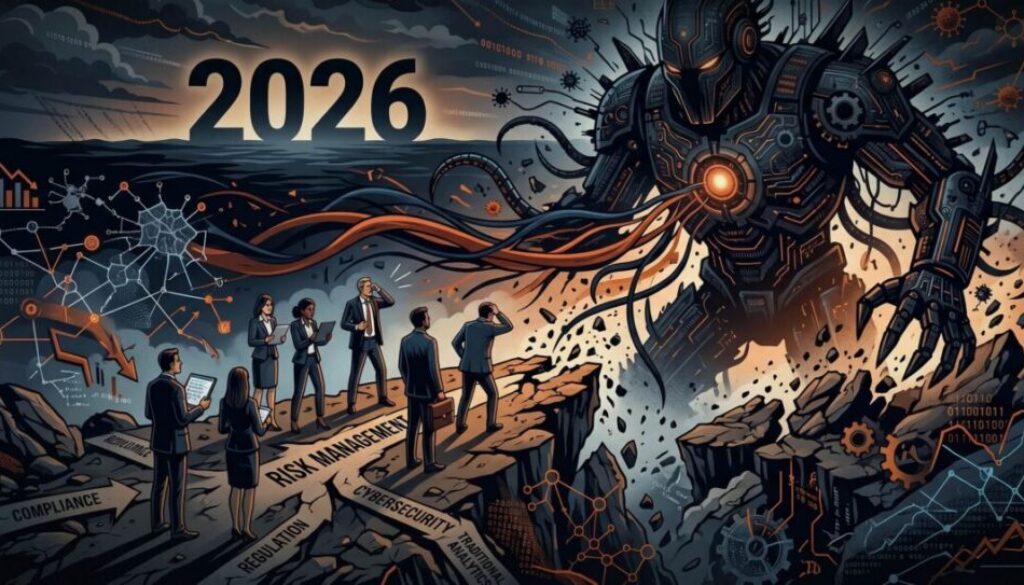
AI emerges as the biggest risk for financial leaders in 2026

New research from the Society of Actuaries has found insurance and financial services leaders across a range of sectors all named artificial intelligence as the top emerging risk for 2026 and in the years to come.
“The study suggests that AI is becoming a core strategic risk. It’s not just this IT sort of question; it’s a whole business model sort of question,” Dale Hall, managing director of research, Society of Actuaries, said.
There’s no doubt that AI continues to breed innovation in the global insurance landscape, enhancing products and services and opening a new realm of possibilities.
However, it also comes with no small share of challenges for the industry, and significant uncertainty that some companies remain uncomfortable with.
“Near-term risks were a little bit diverse across the type of insurer — life insurers on financial volatility, property and casualty insurers on extreme weather, consulting firms on AI. But when we ask all those groups about what is on the horizon three, five, seven years down the road, they all gravitated much, much more towards technology risk,” Hall noted.
Describing AI as “the current unknown on the horizon,” he pointed out that while leaders may be concerned with immediate factors impacting operations, such as income statements and balance sheets, “a lot of people are starting to put a lot of focus on the evolution of technology risks for the future.”

Top risk varies by sector
The SOA 2026 Emerging Risk Survey is the 19th edition of the study. It surveyed SOA members and risk managers in the insurance, financial services and consulting services industries across the U.S. and Canada.
It found that the top emerging short-term risk varied by sector, with C-suite leaders most concerned about economic and geopolitical risks; life insurers most concerned about financial volatility; P/C insurers most concerned about extreme weather events, and consulting firms most concerned about AI.
“The consulting firm side was especially more focused in 2026 as a near-term risk on artificial intelligence. A lot of those companies serving the insurance and financial services industry are working on digital transformation and the impact of artificial intelligence,” Hall said.
He noted that this is different from previous years, with technology steadily earning its place on the radar since Gen AI first began going mainstream.
“Longitudinally, we have the ability here with this study to look at this over time. Certainly, since 2022 is an inflection point; that’s when OpenAI brings out a more public generative pretrained transformer model. In turn, many other firms are bringing their generative AI models to bear,” Hall added.
“At that point, AI adverse outcomes and technology risks start to grow. They start to become more and more prominent among the surveys that we’ve done.”
The digital transformation’s front lines
Hall explained that AI may be the top emerging risk for consulting firms because many are “on the front lines” of digital transformation, providing software and professional services to insurance and financial services.
“They’re kind of on the front lines of that AI revolution in several shapes and forms. They’re likely to be among the first to use that technology in positive ways, but also feel some direct impacts if it becomes a risk to their organization or if companies need to or are cutting back on consulting services,” he noted.
He underscored that the results suggest consulting firms are “just paying close attention to any artificial intelligence, any adverse outcomes that might be triggered by artificial intelligence and paying close attention that way.”
However, he also pointed out that there are both risks and rewards for those leading the AI charge.
“It’s like any risk — it’s also an opportunity. They’re the ones who can help companies put new technology into place. There’s also an opportunity for them to be part of what’s growing as this risk management and governance oversight in the insurance and financial services industries as companies adopt artificial intelligence,” Hall said.
Preparation is the key
The best thing firms that see AI as an emerging risk can do is prepare themselves well, Hall suggested, whether that’s adhering to risk management practices or building skills well ahead of time.
“I think there’s a range of good risk management practices beyond even this study. At the Society of Actuaries, our research institute, we’ve been investing a lot of time in what is good AI risk management, what is good AI governance,” Hall said.
Insurance companies can also look to model oversight as a strong base to work from in building strong AI governance guidance. Hall mentioned the NAIC Model Bulletin as a point of reference.
“I think, too, that incorporating your AI risk management into your existing enterprise risk management is a really important topic. And then things like strengthening your cyber controls, building up your workforce to be able to use it constructively and make good models and interpret the outputs correctly and understand where AI should support judgment rather than replace it,” Hall said.
© Entire contents copyright 2026 by InsuranceNewsNet.com Inc. All rights reserved. No part of this article may be reprinted without the expressed written consent from InsuranceNewsNet.com.
The post AI emerges as the biggest risk for financial leaders in 2026 appeared first on Insurance News | InsuranceNewsNet.