
PwC: Turning AI risks into opportunities can bring competitive advantage

In an environment where most companies are taking the same measured approach to AI adoption, leaders who turn risks into opportunities can set their brand apart from the crowd, according to Michelle Horton, risk and regulatory health industries practice leader, PwC.
Data from PwC’s 2026 C-Suite Outlook indicates most leaders see AI adoption as a major growth driver, even as concerns around cyber attacks and regulatory complexity increase.
“There may be executives and leaders who find comfort in riding along with the pack. But what that does provide is opportunities for those who want to break away and do something different,” Horton said.
“But it’s going to take folks who have confidence in decision making; they feel like they’ve got a good lay of the land and there’s an opportunity for competitive advantage by taking advantage of some of the risks and turning them into opportunities.”
‘Heavy focus on AI’
Sixty percent of the executives who responded to PwC’s survey said the speed of technology adoption and scaling drives growth. A similar 58% held the same view about the pace of return on investment for AI, although 81% said they’re at least a year away from seeing meaningful returns beyond efficiency.
“It was the top area of investment. When we were asking about the moves that executives were making, the one that they responded to making the most impact around was technology and AI investment,” Horton said.

Thirty-eight percent of respondents said they increased tech and AI investments, while 62% said they’ve improved technology adoption and innovation — leading to greater strategic agility, Horton noted — and 33% said they are rebalancing their workforce across humans and AI.
For the financial services sector specifically, 95% of respondents said they are either maintaining, increasing or starting new spending on AI and technology.
“So, basically, AI is becoming central to decision-making,” Horton said. “There’s a heavy focus on AI. I think it’s a no-brainer; everyone needs to be thinking about this. But, again, it’s more of the same. Everyone’s commenting on the same themes. … Everyone’s moving together at this point, but who is actually going to get ahead?”
AI emerges as top business risk
While AI opportunities were a key priority for executives, most respondents also listed AI-related cyber attacks and regulatory complexity as their top business risks — even above an uncertain macroeconomic environment.
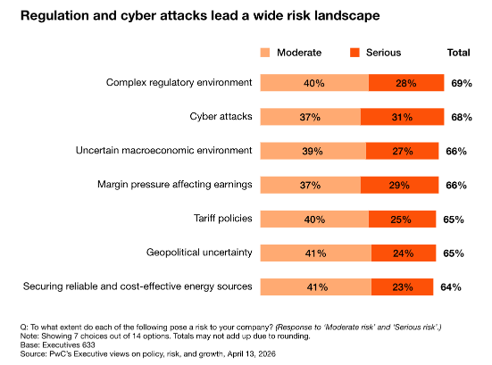
When asked to identify the top risks for their respective companies, the top picks were a complex regulatory environment (69%), cyber attacks (68%), an uncertain macroeconomic environment (66%) and margin pressure affecting earnings (66%).
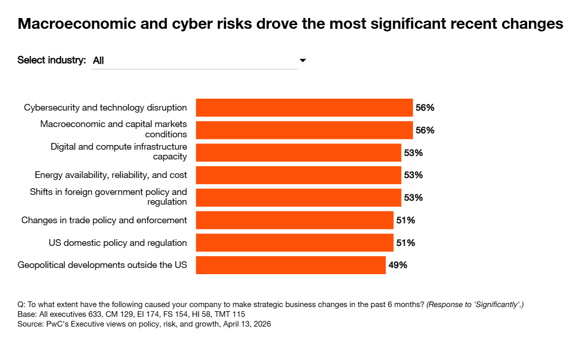
Fifty-six percent of respondents also cited cybersecurity and technology disruption — including cyber attacks, ransomware and the like — and macroeconomic and capital markets conditions as the biggest drivers of significant strategic business changes in 2026.
“In the most recent history, we always see cyber being a significant risk,” Horton said. “It’s usually at the top of the list, and that hasn’t changed. With AI, the tech surface is changing, so certainly top of mind as companies start to adopt more AI and we have new technologies coming out that can be used for both good and bad.”
She also said regulatory complexity will “continue to be a challenge,” especially with “a patchwork of regulatory requirements” that can differ significantly, and some areas still lack clear AI regulations at all.
“Some are country-driven, where you have different requirements in the EU versus the US, and then we have different state requirements around AI and data use. So, it does get complicated,” Horton said.
‘Common discomfort’ drives opportunity
The survey’s results indicate many executives are in the same proverbial boat when it comes to AI, which leads to the question of how companies can stand apart from the crowd.
“Going through the data, we found that it’s almost like there’s comfort in the common discomfort, because these executives are all feeling the same challenges or similar types of challenges — adoption of AI, dealing with cybersecurity threats, changing geopolitical environment — it’s almost like everyone’s in that spot,” Horton explained.
“What we read between the lines there is that, yes, they may be more comfortable, but it may mean that no one’s really differentiating themselves. So, who’s getting ahead then?”
She suggested that the execution of AI strategies will differentiate leaders as they leverage risks to outpace competitors.
“With the advanced technology we have in AI, there are ways to really look at your different options and think about the scenarios that might play out and what options you have to make a move now or maybe in the future. I think companies have more insight at their fingertips. It’s just a matter of taking the time to pull it together and use it for more competent decision making,” Horton said.
The PwC April 2026 C-Suite Outlook was conducted March 12-20, 2026. PwC surveyed 633 executives and financial leaders across the United States in multiple industries, including financial services.
© Entire contents copyright 2026 by InsuranceNewsNet.com Inc. All rights reserved. No part of this article may be reprinted without the expressed written consent from InsuranceNewsNet.com.
The post PwC: Turning AI risks into opportunities can bring competitive advantage appeared first on Insurance News | InsuranceNewsNet.