

Progressive think tank proposes plan to lower health care costs

A progressive public policy think tank announced a health care plan that it said would deliver immediate relief on premiums, deductibles and insurance denials.
The Center for American Progress today revealed its proposal, “A Patient’s Bill of Rights to Lower Health Care Costs.”
“The astronomical and rising cost of health care in America is at a breaking point,” CAP said in its report.
The CAP proposal calls for what it described as “bold actions” to:
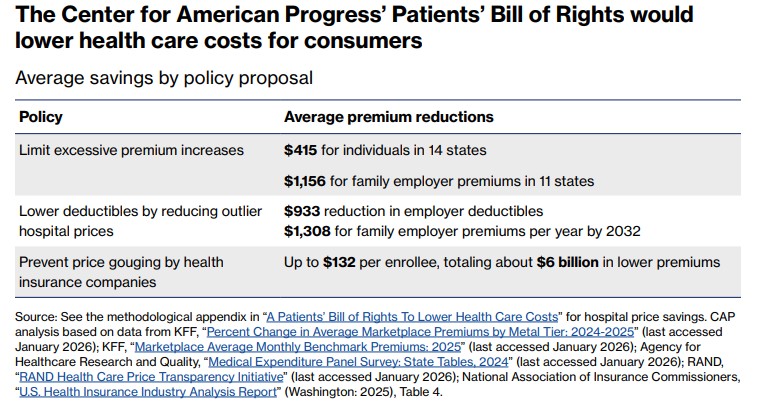
■ Limit excessive premium increases, decreasing average premiums by $415 for individuals in 14 states and by $1,156 for family employer coverage in 11 states.
■ Lower deductibles by reducing outlier hospital prices, cutting average employer deductibles in half in concentrated markets and lowering average family premiums for employer coverage by $1,308 per year by 2032.

■ Prevent price gouging by health insurance companies, reducing average premiums by up to $132 per enrollee per year for a total of about $6 billion per year.
■ Ban and replace prior authorization.
A key theme of CAP’s report is that health care markets are highly concentrated, driving up medical prices and premiums. Excessive rent seeking by some health insurance companies and large hospitals fuels higher costs and slows wage growth. Because mass consolidation of health insurance companies, pharmacy benefit managers and providers has already occurred — and reversing it would be difficult, especially in the near term — CAP said its proposed reforms are necessary to bring down health care costs.
“Healthy regulation is critical to creating downward pressure on costs and aligning incentives toward less, not more, burden to consumers,” the report said.
The reform agenda proposed by CAP in its report is designed to deliver immediate relief for people’s top concerns about their health insurance until broader reforms can be implemented. It is similar in nature to Medicare prescription drug negotiation, which is popular among beneficiaries and delivers near-term relief.
CAP supports reforms to expand and strengthen Medicare prescription drug negotiation, such as expanding the number of drugs subject to negotiation to at least 50 drugs per year and incorporating international pricing into the negotiation. CAP also supports banning excessive markups charged by PBMs and extending caps on drug costs, the price of insulin, and drug price inflation to commercial insurance.
In the future, CAP plans to propose additional reforms focused on prescription drug costs and the supply of medical providers.
CAP has also proposed and continues to support the federal government offering a Medicare plan to individuals and employers. This Medicare plan could pay hospitals at 200% of Medicare rates. It also could pay physicians at the median of commercial prices – about 130% of Medicare rates – and pay Medicare-negotiated prices for prescription drugs. Like Medicare, the plan would cap drug price inflation.
Limiting excessive premium increases
CAP proposes that premium increases exceeding medical trend — the growth in the cost of treating patients from year to year — be presumed excessive. The measure of medical trend should be determined by the Office of the Actuary in the Centers for Medicare and Medicaid Services.
Even if premium increases are presumed excessive, health insurers would have the opportunity to justify them by publicly submitting actuarial analyses certified as independent. OACT should review the submission, together with its own analysis, to determine whether the proposed premium increase is justified. Premium increases that are found to be excessive should be modified, lowering premiums for consumers.
Lower deductibles; reducing outlier hospital prices
CAP proposes legislation to limit hospital prices in concentrated markets so that prices cannot exceed three times the Medicare rates. Because commercial hospital prices average about 250% of Medicare rates, this cap would focus on outliers at the top of the price distribution.
The cap would also apply to the prices that hospitals charge employers that self-insure. Under the proposal, employers would not need to rely on an insurer middleman to negotiate down excessive hospital prices.
Plans should be required to return their savings from the price cap to workers in the form of lower deductibles, the proposal said. For the average employer plan in concentrated markets, CAP conservatively estimates an average deductible reduction of $933 — cutting the current average deductible in about half.
CAP also proposes limiting the growth in hospital prices for hospitals with prices above the statewide median. CAP estimates that the cap on hospital price growth would reduce average family premiums for employer coverage by $1,308 per year by 2032 in concentrated markets.
Prevent price gouging by health insurers
CAP contends that health insurers have evaded and abused federal rules around medical loss ratios. When insurers increase both spending and premiums, they can increase their profits, CAP said. As a result, insurers are insensitive to increases in provider prices — higher prices translate to higher premiums and higher profits.
The limit on profits and administrative costs should be decoupled from an insurer’s spending and premiums — so that an insurer cannot boost profits by increasing spending and premiums, CAP proposed. Instead, insurers would need to compete by lowering premiums, negotiating lower provider prices, and providing quality services that attract enrollment.
Exclude price markups on subsidiaries
Health insurers should be prohibited from owning providers, pharmacies and PBMs, the CAP report proposed.
CAP supports the recent bipartisan legislation sponsored by Sens. Elizabeth Warren, D-Mass., and Josh Hawley, R-Mo., to break up health insurance companies, saying, “This separation is the only way to remove inherent conflicts of interest and self-dealing.”
Ban prior authorization
CAP proposes a ban on prior authorization and its associated claims denials. To ensure that physicians do not overuse costly — and in some cases, harmful — care that departs from clinical guidelines, CAP proposes replacing prior authorization with independent clinical review.
In the year ahead, the Center for American Progress will build upon its agenda to propose additional reforms that reduce prescription drug costs.
© Entire contents copyright 2026 by InsuranceNewsNet.com Inc. All rights reserved. No part of this article may be reprinted without the expressed written consent from InsuranceNewsNet.com.
The post Progressive think tank proposes plan to lower health care costs appeared first on Insurance News | InsuranceNewsNet.