Medicaid expenditures continue to rise as a percentage of total state spending, and much of that goes toward long-term care.
In some states, Medicaid spending already has reached 40% of total state spending. A study conducted for the Minnesota Department of Human Services projected Medicaid expenditures for long-term care would increase 70% between 2023 and 2035.
With an increasing number of Americans needing care, states are looking at how they can mitigate these costs without any significant federal action. Roger Moore, policy director with the National Association of Insurance and Financial Advisors, gave a rundown of how the states are looking at funding long-term care during NAIFA’s Peak 65 Impact Day.
Washington state’s long-term care program
Washington state enacted the nation’s first state-run, statewide long-term care benefit program, known as WA Cares. WA Cares provides a lifetime maximum benefit of $36,500, adjusted annually for inflation, which will be available beginning July 2026.
WA Cares is funded by a mandatory 0.58% payroll tax from all workers in the state, which began in July 2023, with certain exemptions allowed. A worker in Washington must contribute to the fund for 10 years before accessing WA Cares benefits.
In 2024, the state legislature passed a bill that would enable those who contribute to WA Cares but move out of state to access benefits.
In November, voters were given the opportunity to vote on Ballot Initiative 2124, which would have given workers the option to opt out of the mandatory payroll tax that funds WA Cares, which supporters of Washington Cares said would have led to the demise of the program. The initiative did not pass.
California looks at feasibility
In 2023, California’s Long-Term Care Insurance Taskforce considered the feasibility of establishing a program similar to WA Cares. The taskforce provided benefit options ranging from $36,000 to $144,000, with contribution rates between 0.6% and 3%.
The panel submitted findings to the California Department of Insurance in December 2023, although lawmakers have yet to come to a decision.
Minnesota eyes solutions
In 2023, Minnesota’s LTSS Funding and Services Initiative Study offered three possible solutions to address the state’s long-term care needs: care navigation and support services, a Medicare companion product, and an obligatory state insurance program. Minnesota has not taken any action toward a statewide LTC program.
“Ultimately, the problem is that funding long-term care is a big ask,” Moore said. “If you’re developing these big state programs, there’s concern over whether people want it, whether they will vote for it and how much will it cost.
“States have considered it but except for Washington, we haven’t seen anyone take that big dive yet.”
Indexed life and annuity products are the subject of many regulator meetings and class-action lawsuits. Despite that negative publicity, indexed life and annuity sales are booming.
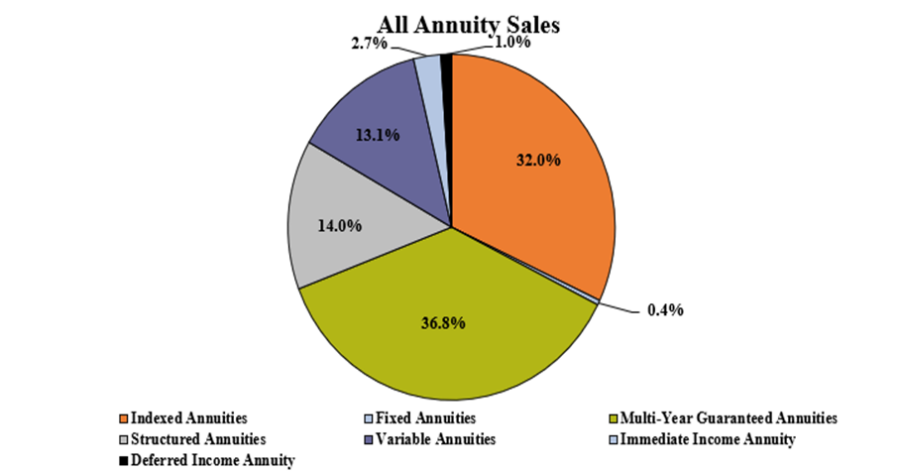
Wink, Inc. reported third-quarter annuity sales of $115.2 billion, up 6.6% compared to the previous quarter. All annuities include the multi-year guaranteed annuity, traditional fixed annuity, indexed annuity, structured annuity, variable annuity, immediate income and deferred income annuity product lines.
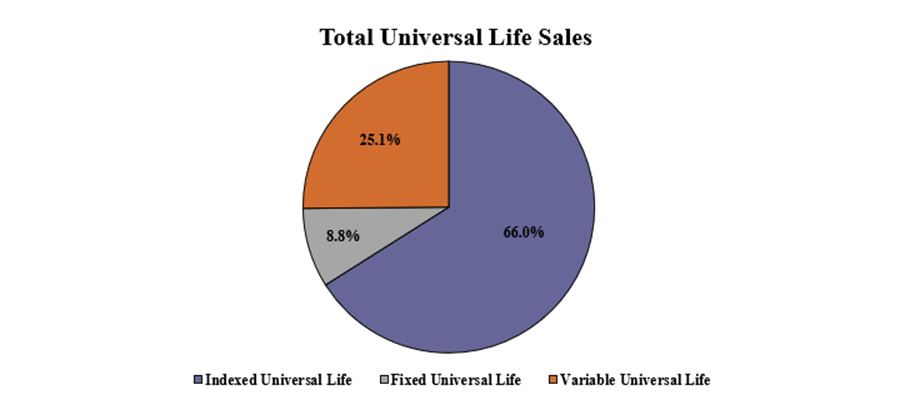
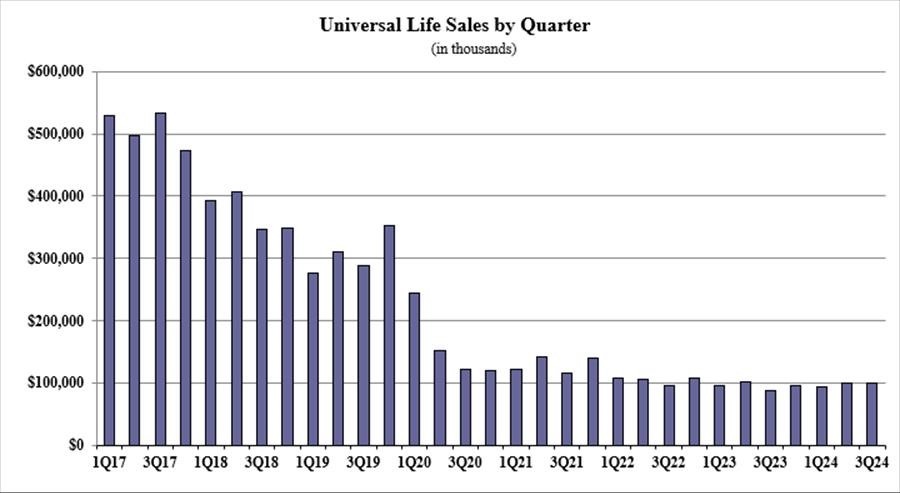
On the life insurance side, indexed products were a lone bright spot, Wink reported. All universal life sales for the third quarter were more than $1.1 billion, down 0.5% compared to the previous quarter. All universal life sales include fixed UL, indexed UL, and variable UL product sales.
The annuity story
Noteworthy highlights for all annuity sales in the third quarter include Athene USA ranking as the No. 1 carrier overall for annuity sales, with a market share of 8.1%. Massachusetts Mutual Life Companies came in second place, while Allianz Life, Corebridge Financial, and Jackson National Life rounded out the top five carriers in the market, respectively.
Courtesy of Wink, Inc.
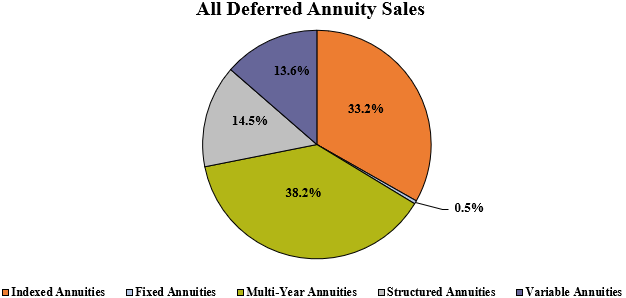
Total third-quarter sales for all deferred annuities were $110.9 billion, up 6% compared to the previous quarter and up 40% compared to the same period last year. All deferred annuities include the multi-year guaranteed annuity, traditional fixed, indexed annuity, structured annuity and variable annuity product lines.
Noteworthy highlights for all deferred annuity sales in the third quarter include Athene USA ranking as the No. 1 carrier overall for deferred annuity sales, with a market share of 8.4%. Massachusetts Mutual Life Companies continued in the second-ranked position, while Allianz Life, Corebridge Financial, and Equitable Financial completed the top five carriers in the market, respectively. Massachusetts Mutual Life’s Stable Voyage 3-Year, a MYG annuity, was the No. 1 selling deferred annuity, for all channels combined, in overall sales for the second consecutive quarter.
Courtesy of Wink, Inc.
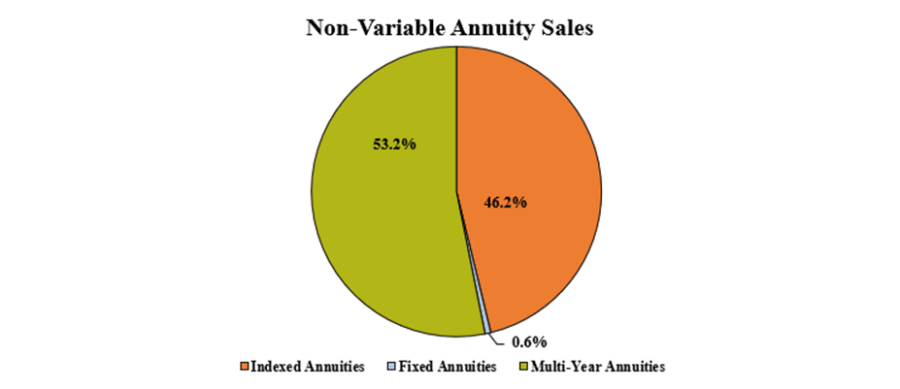
Total third quarter non-variable deferred annuity sales were $79.7 billion, up 8.2% compared to the previous quarter and up 45.5% compared to the same period last year. Non-variable deferred annuities include the MYG annuity, traditional fixed annuity, and indexed annuity product lines.
Noteworthy highlights for non-variable deferred annuity sales in the third quarter include Athene USA ranking as the No. 1 carrier overall for non-variable deferred annuity sales, with a market share of 11.3%. Massachusetts Mutual Life Companies continued in the second-ranked position, while Corebridge Financial, Allianz Life, and Global Atlantic Financial Group completed the top five carriers in the market, respectively.
Massachusetts Mutual Life’s Stable Voyage 3-Year, a MYG annuity was the No. 1 selling non-variable deferred annuity for the quarter, for all channels combined, in overall sales for the second consecutive quarter.
Courtesy of Wink, Inc.
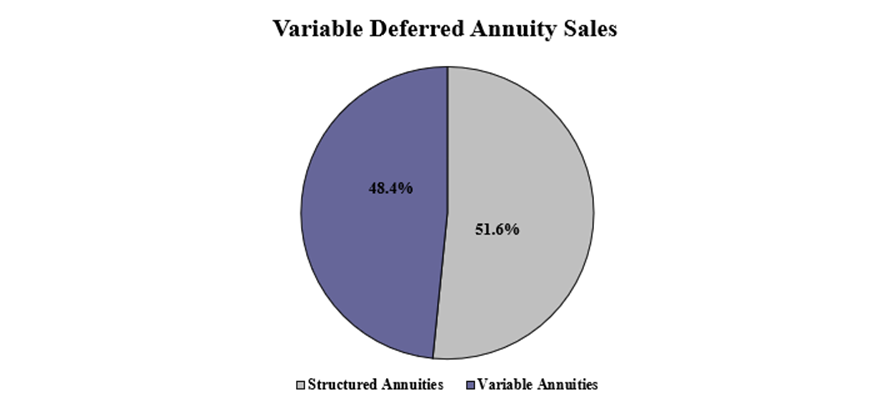
Total third-quarter variable deferred annuity sales were $31.2 billion, up 0.7% compared to the previous quarter and up 27.7% compared to the same period last year. Variable deferred annuities include structured annuity and variable annuity product lines.
Noteworthy highlights for variable deferred annuity sales in the third quarter include Equitable Financial ranking as the No. 1 carrier overall for variable deferred annuity sales, with a market share of 18.3%. Jackson National Life continued in the second-place position, as Lincoln National Life, Allianz Life, and Prudential concluded as the top five carriers in the market, respectively. Equitable Financial’s Structured Capital Strategies Plus 21, a structured annuity, was the No. 1 selling variable deferred annuity, for all channels combined, in overall for the second consecutive quarter.
Courtesy of Wink, Inc.
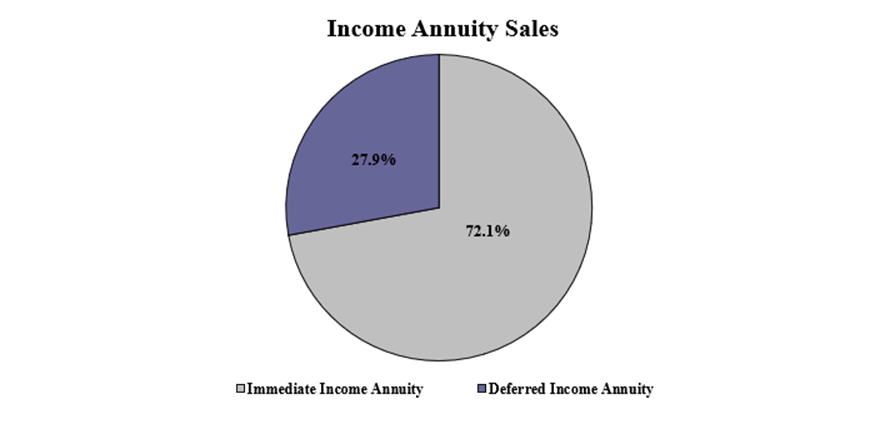
Total third quarter income annuity sales were $4.3 billion, up 27.4% compared to the previous quarter. Income annuities include immediate income annuity (SPIA) and deferred income annuity product lines.
Noteworthy highlights for income annuity sales in the third quarter include New York Life ranking as the No. 1 carrier overall for income annuity sales, with a market share of 36.1%. Massachusetts Mutual Life Companies moved into second-ranked position, as Nationwide, Western-Southern Life Assurance Company, and Penn Mutual concluded the top five carriers in the market, respectively.
Courtesy of Wink, Inc.
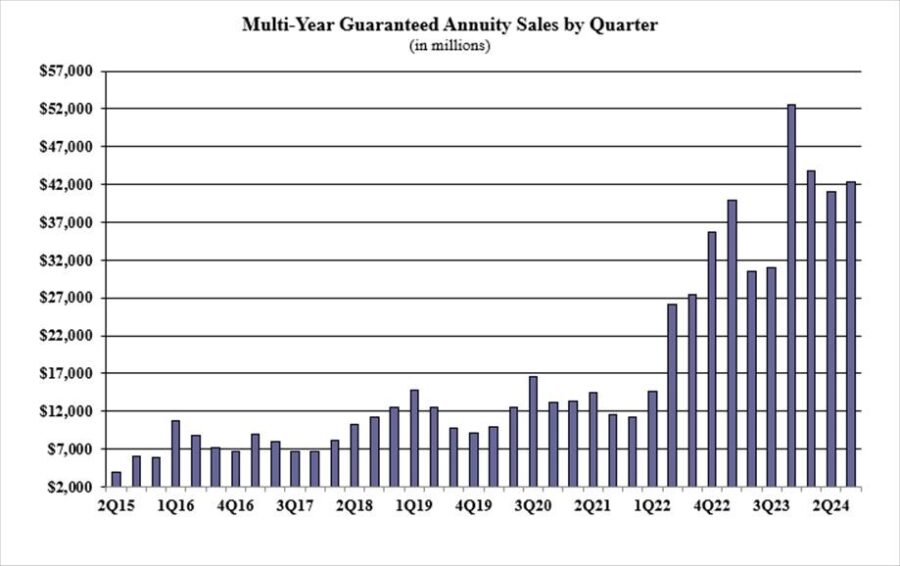
Multi-year guaranteed annuity sales in the third quarter were $42.4 billion, up 3.3% compared to the previous quarter, and up 36.9% compared to the same period, last year. MYGAs have a fixed rate that is guaranteed for more than one year.
Noteworthy highlights for MYGAs in the third quarter include Massachusetts Mutual Life Companies ranking as the No. 1 carrier, with a market share of 14.2%. Athene USA continued in the second-ranked position, while Corebridge Financial, New York Life and Global Atlantic Financial Group rounded out the top five carriers in the market, respectively. Massachusetts Mutual Life’s Stable Voyage 3-Year product was the No. 1 selling multi-year guaranteed annuity, for all channels combined, for the second consecutive quarter.
Courtesy of WInk, Inc.
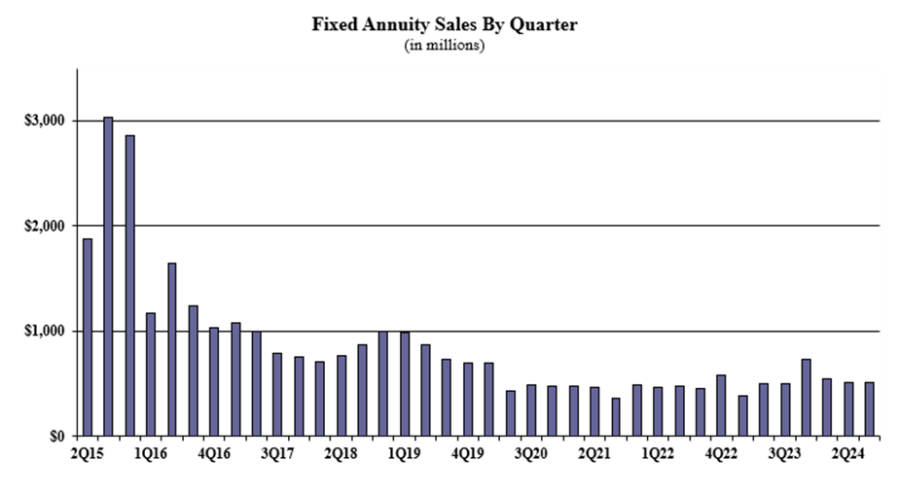
Traditional fixed annuity sales in the third quarter were $516.7 million, up 2% compared to the previous quarter, and up 4.2% compared to the same period last year. Traditional fixed annuities have a fixed rate that is guaranteed for one year only.
Noteworthy highlights for traditional fixed annuities in the third quarter include Global Atlantic Financial Group ranking as the No. 1 carrier in fixed annuities, with a market share of 15.7%. CNO Companies ranked second, while Modern Woodmen of America, CL Life and EquiTrust completed the top five carriers in the market, respectively. Forethought Life’s ForeCare Fixed Annuity was the No. 1 selling fixed annuity, for all channels combined, for the seventeenth consecutive quarter.
Courtesy of Wink, Inc.
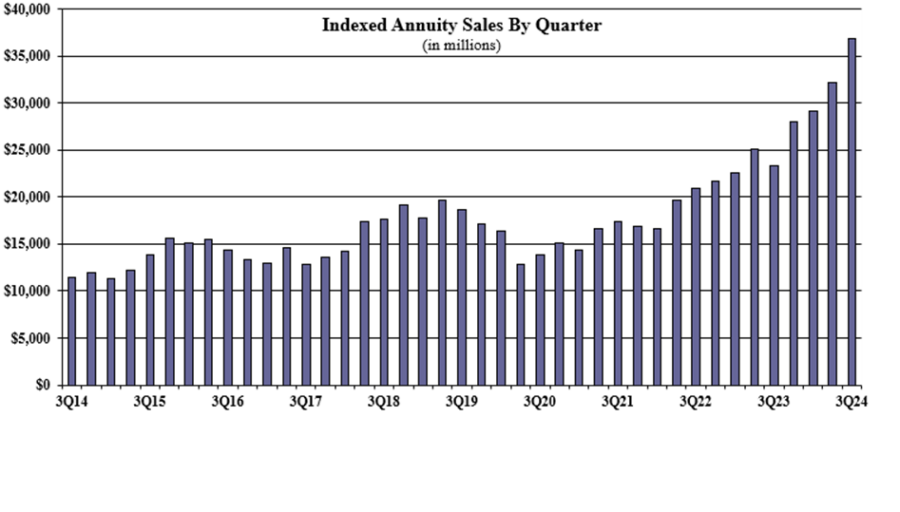
Indexed annuity sales for the third quarter were $36.8 billion; sales were up 14.6% compared to the previous quarter, and up 57.8% compared to the same period last year. Indexed annuities have a floor of no less than zero percent and limited excess interest that is determined by the performance of an external index, such as Standard and Poor’s 500. This was a record-setting quarter for indexed annuity sales, topping the second-quarter 2024 record by 14.6%.
Noteworthy highlights for indexed annuities in the third quarter include Allianz Life ranking as the No. 1 seller of indexed annuities, with a market share of 13%. Sammons Financial Companies ranked second, while Athene USA, Corebridge Financial, and Global Atlantic Financial Group completed the top five carriers in the market, respectively. Allianz Life’s Allianz Benefit Control Annuity was the No. 1 selling indexed annuity, for all channels combined, for the quarter.
Sheryl Moore, CEO of both Wink, Inc., and Moore Market Intelligence, said, “It was another record-setting quarter for indexed annuity sales. Already YTD sales have nearly beat out the full year 2023’s results.”
Courtesy of Wink, Inc.
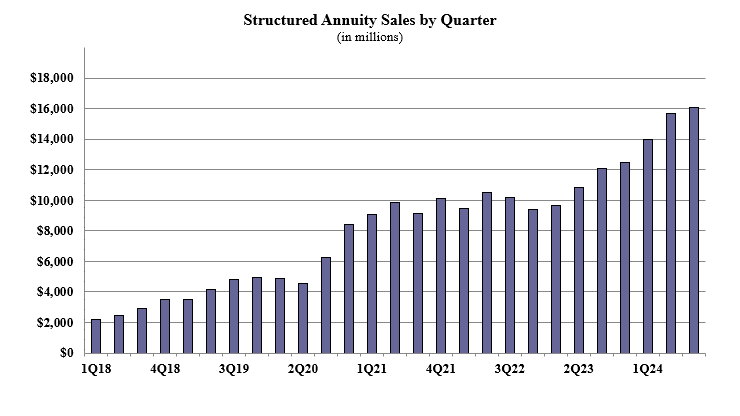
Structured annuity sales in the third quarter were $16.1 billion, up 2.8% compared to the previous quarter, and up 33.1% compared to the year-ago quarter. Structured annuities have a limited negative floor and limited excess interest that is determined by the performance of an external index or subaccounts. This was a record-setting quarter for structured annuity sales, topping the second quarter 2024 record by 2.8%.
Noteworthy highlights for structured annuities in the third quarter include Equitable Financial ranking as the No. 1 carrier in structured annuity sales, with a market share of 22.5%. Allianz Life ranked second, while Prudential, Brighthouse Financial, and Jackson National Life completed the top five carriers in the market, respectively. Equitable Financial’s Structured Capital Strategies Plus 21 was the No. 1 selling structured annuity, for all channels combined, for the second consecutive quarter.
“Structured annuity sales YTD have already eclipsed total 2023 results,” Moore said. “It appears that VAs are losing market share to their indexed brethren.”
Courtesy of Wink, Inc.
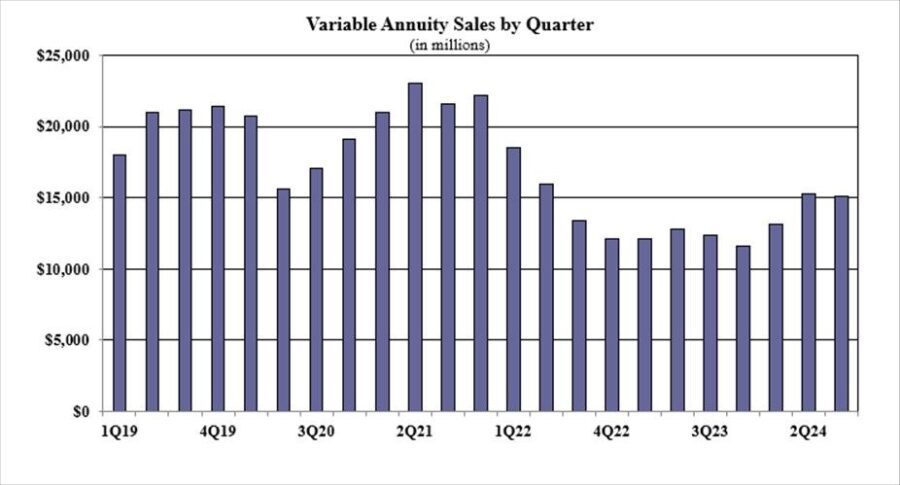
Variable annuity sales in the third quarter were $15.1 billion, down 1.4% compared to the previous quarter, and up 22.3% compared to the same period last year. Variable annuities have no floor, and the potential for gains/losses is determined by the performance of subaccounts that may be invested in an external index, stocks, bonds, commodities, or other investments.
Noteworthy highlights for variable annuities in the third quarter include Jackson National Life ranking as the No. 1 carrier in variable annuities, with a market share of 17.1%. Equitable Financial ranked second, while Nationwide, New York Life, and Lincoln National Life finished as the top five carriers in the market, respectively. Jackson National’s Perspective II Flexible Premium Variable & Fixed Deferred Annuity was the No. 1 selling variable annuity for the twenty-second consecutive quarter, for all channels combined.
“The steady increase in the market has lent to stronger VA sales, but structured annuities will likely continue to rule the variable subset,” explained Moore.
Courtesy of Wink, Inc.
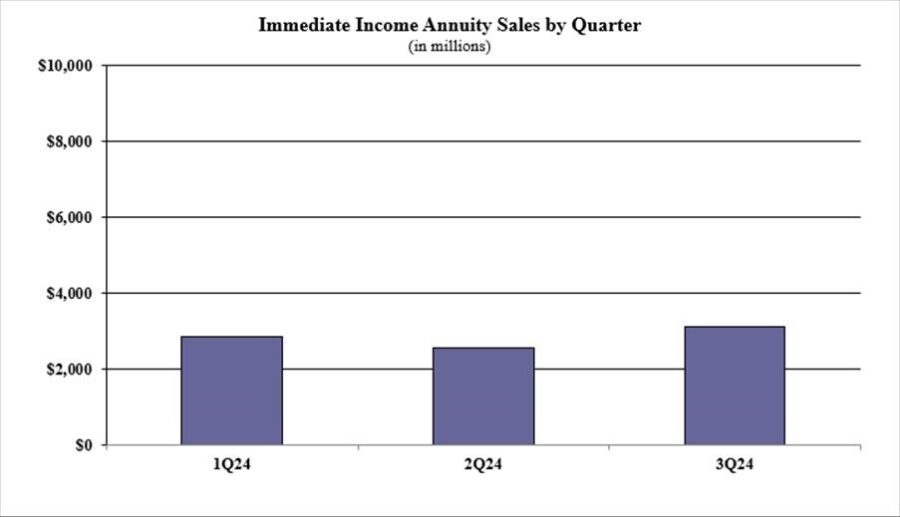
Immediate income annuity (Single Premium Immediate Annuity) sales in the third quarter were $3.1 billion; up 21.8% compared to the previous quarter.
Noteworthy highlights for immediate income annuities in the third quarter include New York Life ranking as the No. 1 carrier in immediate income annuities, with a market share of 32.9%. Massachusetts Mutual Life Companies ranked second, while Nationwide, Western-Southern Life Assurance Company, and Penn Mutual finished as the top five carriers in the market, respectively.
Courtesy of Wink, Inc.
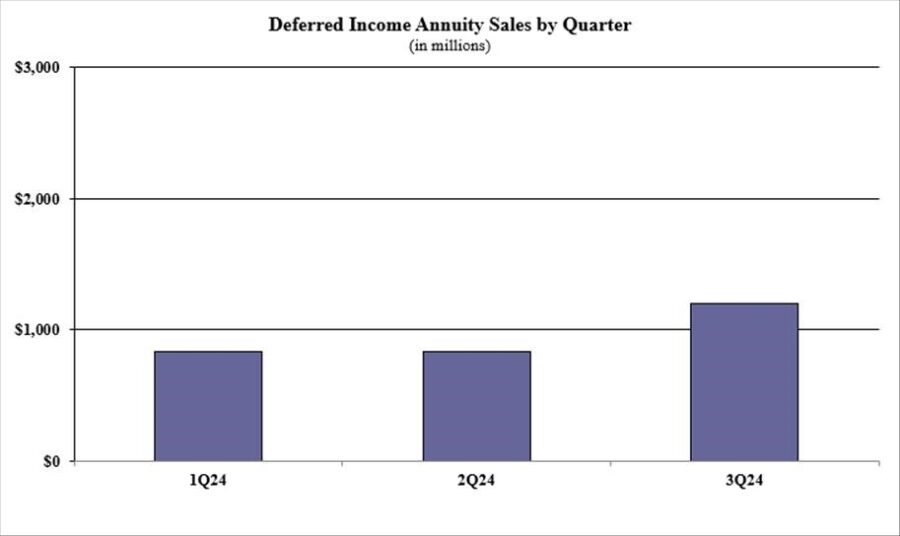
Deferred income annuity sales in the third quarter were $1.2 billion; up 44.6% compared to the previous quarter.
Noteworthy highlights for deferred income annuities in the third quarter include New York Life ranking as the No. 1 carrier in deferred income annuities, with a market share of 44.5%. Massachusetts Mutual Life Companies ranked second, as Western-Southern Life Assurance Company, Integrity Life Companies, and Corebridge Financial finished as the top five carriers in the market, respectively.
Courtesy of Wink, Inc.
The life story
Noteworthy highlights for total all universal life sales in the third quarter included National Life Group ranking as No. 1 in overall sales for all universal life sales, with a market share of 10.9%. Transamerica Life’s Transamerica Financial Foundation IUL was the No. 1 selling product for all universal life sales, for all channels combined, for the third consecutive quarter.
Courtesy of Wink, Inc.
Non-variable universal life sales for the third quarter were $847.8 million; sales remained flat when compared to the previous quarter and up 9.5% compared to the same period last year. Non-variable universal life sales include both indexed UL and fixed UL product sales.
Noteworthy highlights for total non-variable universal life sales in the third quarter included National Life Group retaining the No. 1 overall sales ranking for non-variable universal life sales, with a market share of 14.6%. Transamerica Life’s Transamerica Financial Foundation IUL was the No. 1 selling product for non-variable universal life sales, for all channels combined, for the fourteenth consecutive quarter.
Courtesy of Wink, Inc.
Fixed UL sales for the third quarter were $100 million, down 0.5% compared to the previous quarter and up 15.2% compared to the same period last year.
Items of interest in the fixed UL market included Nationwide retaining their No. 1 ranking in fixed universal life sales, with a 16.7% market share, John Hancock, Pacific Life Companies, Protective Life Companies, and Prudential completed the top five, respectively.
Pacific Life’s Pacific Life Promise GUL was the No. 1 selling fixed universal life insurance product, for all channels combined for the quarter. The top primary pricing objective of No Lapse Guarantee captured 39.5% of sales. The average fixed UL target premium for the quarter was $7,757, an increase of nearly 13% from the prior quarter.
“The second quarter was a strong quarter for life insurance sales,” Moore said, “so sales being flat this quarter isn’t such a surprise.”
Courtesy of Wink, Inc.
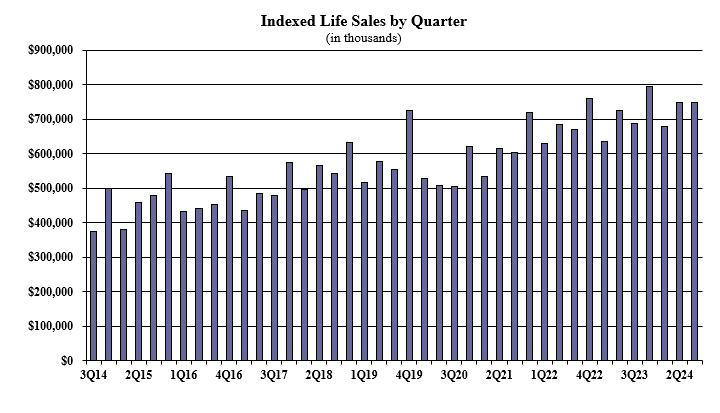
Indexed life sales for the third quarter were $748.8 million, up 0.2% compared with the previous quarter, and up 8.9% compared to the same period last year. Indexed life sales include both indexed UL and indexed whole life.
Items of interest in the indexed life market included National Life Group keeping their No. 1 ranking in indexed life sales, with a 16.4% market share, Transamerica, Pacific Life Companies, Nationwide, and Lincoln National Life rounded-out the top five, respectively.
Transamerica Life’s Transamerica Financial Foundation IUL was the No. 1 selling indexed life insurance product, for all channels combined, for the fourteenth consecutive quarter. The top primary pricing objective for sales this quarter was Cash Accumulation, capturing 71.7% of sales. The average indexed life target premium for the quarter was $13,156, an increase of 22% from the prior quarter.
“Indexed life was the only line of business which experienced an increase in sales from last quarter,” commented Moore. “And sales were only up 0.2%.”
Courtesy of Wink, Inc.
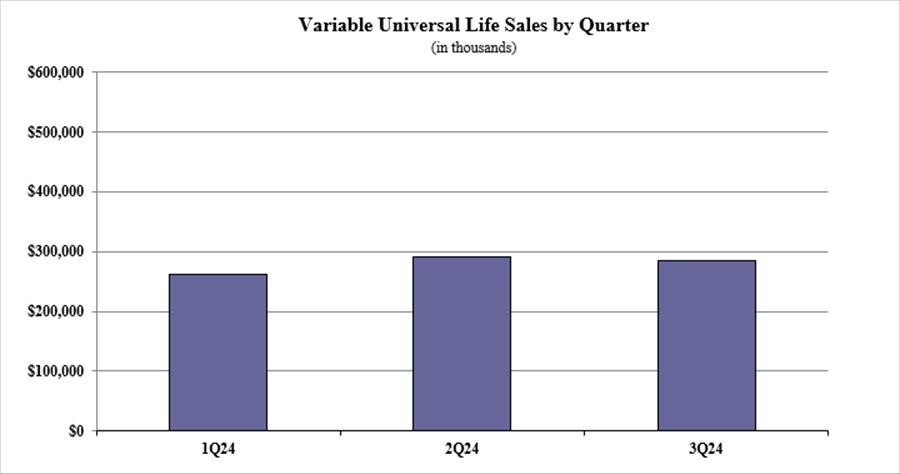
Variable Universal Life sales for the third quarter were $284.7 million, down 2.3% compared with the previous quarter.
Items of interest in the variable universal life market included Prudential retaining the No. 1 ranking in variable universal life sales, with a 34.3% market share, Pacific Life Companies, RiverSource Life, John Hancock and Nationwide completed the top five, respectively.
Pruco Life’s VUL Protector was the No. 1 selling variable universal life insurance product, for all channels combined for the third consecutive quarter. The top primary pricing objective for sales this quarter was Cash Accumulation, capturing 54.5% of sales. The average variable universal life target premium for the quarter was $20,001, a decline of nearly 2% from the prior quarter.
Courtesy of Wink, Inc.
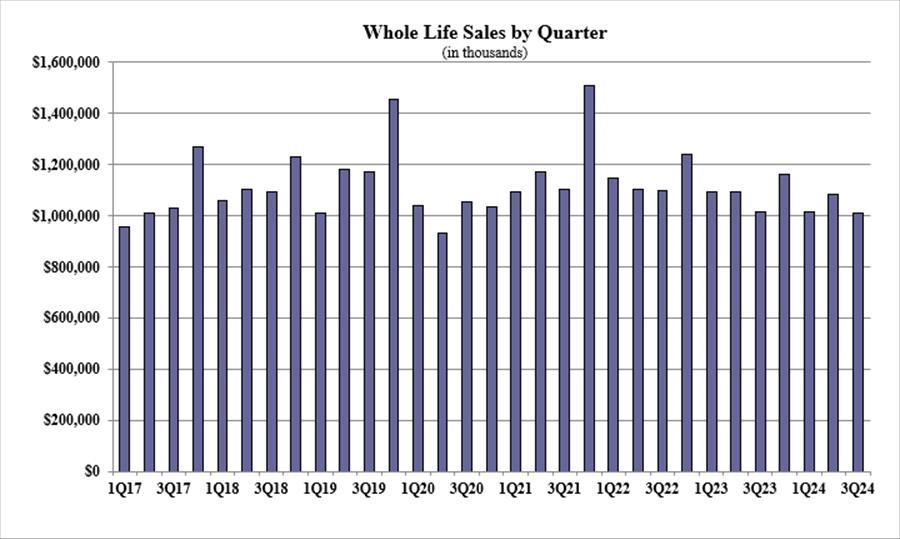
Whole life third quarter sales were $1 billion, down 6.7% compared with the previous quarter, and down 0.8% compared to the same period last year. Items of interest in the whole life market included the top primary pricing objective of final expense capturing 56.1% of sales. The average premium per whole life policy for the quarter was $3,655, an increase of more than 4% from the prior quarter.
Courtesy of Wink, Inc.
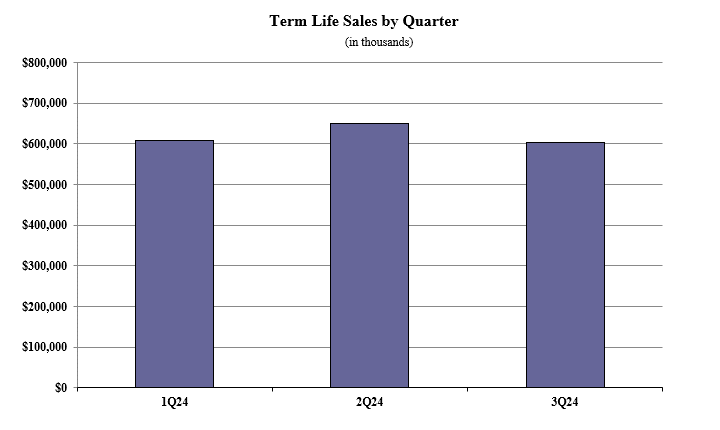
Term life third quarter sales were $602.3 million; down 7.4% compared with the previous quarter.
Items of interest in the term life market included Prudential ranking as No. 1 in term life sales, with a 5.4% market share. Pacific Life Companies, Corebridge Financial, Protective Life Companies and Massachusetts Mutual Life Companies rounded the top five, respectively.
Pruco Life’s Term Essential 10 was the No. 1 selling term life insurance product, for all channels combined, for the quarter. The average annual term life premium per policy reported for the quarter was $2,412, a decline of more than 19% from the previous quarter.
Courtesy of WInk, Inc.
Wink now reports on all annuity and life insurance lines of business.
The insurance industry is at a crossroads, grappling with a multifaceted talent crisis fueled by demographic shifts, technological transformation, and evolving workforce expectations. A recent webinar featuring industry leaders shed light on the challenges and outlined strategies to close the talent gap and secure the future of underwriting.
A perfect storm of challenges
Jennifer Kyung, the CEO and founder of NextGen Underwriting set the stage, describing the unprecedented volatility in underwriting. “We have a confluence of events: an aging workforce, significant advancements in data and technology, and generational shifts in employee expectations,” she said. These factors coincide with a time of heightened demands from both the market and consumers.
Jessica Diffin, talent officer at Liberty Mutual Insurance highlighted the urgency of the issue. “Turnover in underwriting has surged to double digits, a stark change from just a few years ago. It’s taking longer to fill roles, and competition is driving salaries higher,” she noted. Adding to the strain is the “silver tsunami” of impending retirements among experienced underwriters.
Beyond workforce attrition and talent crisis, Diffin pointed out an industry-wide image problem. “Younger workers don’t see insurance, let alone underwriting, as a destination career. We need to change that narrative,” she emphasized.
The role of technology: Friend or foe?
Technology, particularly artificial intelligence (AI) and large language models (LLMs) are reshaping underwriting. Anthony Shapella, deputy chief underwriting officer at Sirius, called attention to AI’s transformative potential: “Underwriting generates vast amounts of text-based data, making it an ideal candidate for LLMs. These technologies can automate repetitive tasks, enhance risk assessment, and free up underwriters for higher-value activities.”
Yet, the integration of AI comes with challenges. Shapella warned of over-reliance on model outputs, especially among less experienced underwriters. “Junior staff may lack the instinct to identify when a model output doesn’t make sense. We need to train them to be informed consumers of AI insights,” he stressed.
Wendy Crosley, global director of underwriting transformation and automation at professional services company WTW, echoed this sentiment, emphasizing the importance of adaptability and trust. “AI is a partnership. The underwriter must know when and how to leverage it,” she said.
A new skill set for the future
As technology automates routine tasks, underwriters must cultivate new skills to stay relevant. Crosley highlighted the importance of data literacy, communication, and adaptability. “Underwriters need to interpret complex data, articulate insights to brokers and customers, and adapt to rapidly evolving tools,” she said.
Matt Waters, head of U.S. middle market at AXA XL, underscored the enduring value of soft skills, describing them as “the art side of the business.” Building relationships, negotiating, and influencing others are still critical, even in an increasingly data-driven environment. “The science of underwriting might level the playing field, but the art of it—how you sell, market, and make decisions—will set you apart,” he explained.
Justin Smith, chief economist at Applied Underwriters, added a cautionary note for actuaries and underwriters alike. “AI will handle many of the tasks actuaries and underwriters currently perform. The challenge will be to adapt, focus on strategic and interpersonal skills, and carve out a role in this evolving landscape,” he said.
Attracting the next generation of talent
The industry’s future hinges on attracting and retaining younger workers, particularly millennials and Gen Z. Diffin outlined the unique value proposition this demographic looks for: purpose-driven work, workplace flexibility, personalized career experiences, and access to innovative technology.
“Millennials want to know how they fit into the big picture. They value social justice, climate action, and mental health support,” she said. With average tenures hovering around two years, organizations must focus on providing clear career paths, mobility, and regular feedback.
Diffin stressed the need for strategic workforce planning. “We can no longer rely on buying talent. We have to build it by investing in skills-based training and development programs,” she said. She also called for leveraging analytics to understand workforce demographics and needs.
Leadership accountability
As automation and AI transform the industry, leadership plays a pivotal role in guiding this transition. “Business leaders must understand technology deeply enough to align it with strategic goals,” Crosley said. This involves not just adopting technology, but integrating it effectively into broader business strategies.
Kyung reinforced this point, emphasizing the importance of transparency and accountability. “Leaders must help underwriters understand what sits behind the models and how automation enhances their work,” she said.
Talent crisis: A collaborative path forward
The online seminar concluded with a call to action for industry stakeholders to work together to address the talent crisis. By reimagining career paths, investing in technology, and cultivating both technical and interpersonal skills, the insurance industry can navigate its current challenges and emerge stronger.
As Kyung aptly summarized, “This is not just about solving today’s problems. It’s about building a sustainable future for underwriting.”
The road ahead is complex, but with the right strategies, the industry can turn its challenges into opportunities and secure the next generation of talent.
Insurers that use generative artificial intelligence have an advantage over their competitors, according to Mark McLaughlin, IBM global insurance director. However, he said the way they leverage it matters, as he provided some insights into a winning strategy.
McLaughlin spoke with InsuranceNewsNet on the heels of IBM’s Institute for Business Value having released a study on how gen AI is being used in the industry.
“Lots of insurers are making AI investments. They talk to us all the time. But how do you build it in a way where you’re actually generating business results?” he said.
IBM’s recommendations include:
Use AI to build customized solutions for clients
Distribute AI throughout the organization
Plan on using a range of AI models
“Use AI to connect the customer to the risk and to the right product. Distribute AI throughout your organization, empower your business users to use it, and use AI to solve the underlying IT problems to make all that faster. The companies that are doing well in insurance with generative AI are all taking advantage of those principles,” McLaughlin said.
Gen AI investments on the rise
IBM’s study found insurance CEOs were divided on whether they see gen AI as a risk or an opportunity. However, 77% of insurance executives who responded believe it is necessary to keep up with competitors. Accordingly, IBM expects AI investments in insurance to increase by as much as 300% over the next two years alone.
That intense competition — and not direct customer demand — is what McLaughlin believes is driving such strong pressure for insurers to invest in AI.
“Something like more than three quarters of those executives are getting pressure from their board, from their employees and from the press. They’re reacting to shareholder concerns and competitive concerns and they absolutely know that if they don’t get AI right and their competitor does, that it’s going to be a problem,” he said.
Disconnect with client expectations
However, IBM pointed to a disconnect between what insurers are focused on when it comes to utilizing AI and what their clients expect out of it.
While insurers were found to look at factors like overall experience, brand consistency and ethics policies, clients were more concerned about practical applications to meet specific needs.
“I think customers are looking for something beyond, well, just have the chatbot use my name [or] have the chatbot speak in a language that’s familiar to me. They’re getting down to the brass tacks of the problem, which is [whether] the product you’re selling is the right product to solve my risk issue and to address my emotional concern about why I’m buying insurance in the first place,” McLaughlin said.
Strategy 1: Build trust and customization
Bridging the disconnect between client expectation and how insurers use AI will come down to building trust and providing customized solutions, McLaughlin suggested.
“I think the insurers need to build in products that link to the data that they’ve got on the customer and on the customer’s risk. They need to build those more tailored products. They need to match those products intelligently to customers, and they need to do so in a way that’s trustworthy,” he said.
IBM’s study found only 29% of insurance clients are comfortable with virtual AI agents providing service. An even lower 26% trust the reliability and accuracy of advice provided by an AI agent.
“The trust scores in the insurance industry are down 25% since pre-COVID. That says it’s really important to get generative AI right in the context of trust,” McLaughlin added.
Strategy 2: Take AI beyond IT
McLaughlin also recommended insurers distribute gen AI capabilities across their entire organization instead of leaving it “locked up” in a single IT department.
“IT can support and help with the technical implementation, but you’ve got to empower your business users with generative AI. You have to help them to apply generative AI in ways that do a better job of serving the customer’s risk,” he said.
At the same time, IT teams can use AI to deal with legacy technical debt — which McLaughlin said over 70% of insurers struggle with.
Strategy 3: Use multiple models
McLaughlin pointed out that many insurers plan to build a single AI model using one of the large language models. However, he advised against this as he said just one tool may not necessarily be the best to meet every need.
“There are specific AI tools you’re going to end up using. Plan ahead. Have tools that will work across a range of AI models; connect to all of your data stores across your organization and across your ecosystem of partners; and govern AI effectively across that range,” he said.
For instance, McLaughlin noted that IBM’s Watson AI has different platforms such as watsonx.ai, watsonx.data and watsonx.governance to meet different specific needs.
IBM is one of the world’s largest, most well-known technology research organizations. Its report, “Generative AI in the Insurance Industry: You Can’t Win If You Don’t Play” included findings from a survey of 1,000 insurance C-suite executives in 23 countries and 4,700 insurance customers in nine countries. The full report can be viewed on their website.
Affordable Care Act marketplace coverage will cost consumers an average of 7% more for 2025 than it did in 2024, according to KFF.
KFF research found insurers requested a median premium increase of 7% for 2025, similar to the 6% premium increase filed for 2024. Insurers cite growing health care prices – particularly for hospital care – as a key driver of premium growth in 2025, as well as growing use of weight loss and other specialty drugs.
Open enrollment for the ACA marketplaces for 2025 began Nov. 1 and continues through Jan. 15, 2025, in most states.
With median premiums on the rise, ValuePenguin reported that for 2025, a silver health plan costs $621 per month on average for a 40-year-old. Rates depend on things like age, the plan tier chosen and the state in which you live.
Most people who buy coverage from HealthCare.gov or a state marketplace don’t pay the full monthly cost for health insurance. More than 90% of health insurance plans from HealthCare.gov or state marketplaces receive rate subsidies. These subsidies lower the monthly cost of health insurance. About 4 in 5 people can get health insurance for $10 or less per month.
Vermont saw the highest percentage of median rate increases for 2025 – with a silver plan for a 40-year-old going up by 27% over the current year. Six states – Alabama, Indiana, Iowa, Louisiana, South Carolina and South Dakota – saw average rates drop from 2024.
ValuePenguin reported UnitedHealthcare has the highest average monthly rate for a 40-year-old with a silver plan: $631. Kaiser Permanente had the cheapest average monthly rate for that same silver plan for a 40-year-old: $507.
Aetna’s average monthly rate for a 40-year-old with a silver plan took the biggest jump over the previous year – 17%. Ambetter’s average monthly rate dropped by 1% for the same silver plan for a 40-year-old.
Those who want a higher level of coverage will pay more for it in 2025, ValuePenguin reports, with the average rate for a platinum plan going up by 13%. Those who want more flexibility in the doctors they see also will pay more for that privilege – with a 40-year-old nonsmoker paying an average monthly premium for a silver plan PPO of $662 as opposed to $560 for an HMO. Monthly premiums for HMO silver plans went up by 9% compared with an 8% increase for an average silver plan PPO.
What will happen to enhanced subsidies?
Meanwhile, enhanced subsidies that lower premium payments for ACA coverage are due to expire in 2025 unless Congress acts to extend them.
First enacted in 2021 under the American Rescue Plan Act, the enhanced subsidies were renewed through the end of 2025 by the Inflation Reduction Act. Since their implementation, ACA marketplace enrollment has grown each year and hit record highs, reaching more than 21 million in 2024. Southern states have seen the most growth in ACA Marketplace signups, KFF reports.
KFF said if these enhanced subsidies are not renewed by Congress and expire at the end of 2025, ACA enrollee premium payments are expected to increase by over 75% on average, with people in some states seeing their payments more than double. Without further extension, the Congressional Budget Office estimates ACA enrollment will drop from 22.8 million in 2025 to 18.9 million in 2026 and fall to 15.4 million in 2030. While some may be able to find other sources of coverage, others will become uninsured.
By the time these enhanced subsidies are currently set to expire at the end of next year, they will have been an integral part of the ACA marketplaces for five years, or nearly half as long as the ACA marketplaces have existed. Millions of enrollees have come to rely on the enhanced subsidies, with more people gaining marketplace coverage since President Joe Biden took office than had signed up for ACA marketplace when the markets first launched in 2014. If the enhanced subsidies expire, almost all ACA marketplace enrollees will experience steep increases in premium payments in 2026. However, the subsidies come at a steep cost to taxpayers, with the CBO projecting that a permanent extension of the subsidies would cost $335 billion over the next 10 years.
KFF’s analysis finds that:
The recent growth in ACA marketplace plan enrollment has been driven primarily by low-income people, with signups by people with incomes up to 2.5 times the federal poverty level growing 115% since 2020.
Enhanced subsidies have cut premium payments by an estimated 44% ($705 annually) for enrollees receiving premium tax credits. If the subsidies expire, most marketplace enrollees will see premium payment increase substantially.
Without these enhanced subsidies, premiums would double or more, on average, for subsidized enrollees in 12 states using Healthcare.gov.
While enhanced subsidies expire at the end of 2025, insurers and regulators will want to know well in advance whether the subsidies will be renewed or discontinued so they can set accurate premiums for 2026.
The incoming Trump administration’s health care priorities are expected to focus on bringing down costs and providing alternatives to Affordable Care Act plans.
That was the word from a panel of analysts from Mercer, who held a webinar on the post-election outlook for benefits policy.
President-elect Donald Trump has been light on benefits policy details, said Geoff Manville, partner with Mercer’s Law and Policy Group. But Trump is expected to revisit some policies from his first term.
Trump is likely to renew efforts to reduce health care costs, expand non-ACA coverage options such as association health plans, and generally support paid leave legislation, Manville said. However, Trump and congressional Republicans are likely to oppose extending enhanced ACA subsidies that are set to expire next year.
“On health care, we don’t see a clear direction with where Trump is going at this point but it will be clearer when he staffs the health policy jobs in his administration,” Manville said, referring to appointing the heads of federal agencies such as the Department of Health and Human Services, the Centers for Medicare and Medicaid Services and the Department of Labor.
Health care affordability is an issue
Health care affordability is one area that has bipartisan support. Manville said both parties want reforms that control costs for employers and consumers. Trump and congressional Republicans are likely to renew their earlier priorities, which include:
Reducing drug costs.
Increasing price transparency and provider competition.
Expanding non-ACA options such as association health plans and short-term limited duration insurance.
Expand and enhance health savings accounts.
Manville noted that Trump also campaigned on requiring employer plans to cover in-vitro fertilization.
While the nation’s eyes are looking at what might happen in Washington in 2025, a backlog of health care issues are awaiting congressional action now and could see some movement in the 2024 lame duck session, Manville said.
Health care reforms that have bipartisan support and could see action this year include:
Pharmacy benefit manager reform. Banning “spread pricing;” requiring disclosures of business practices to plan sponsors and the government; requiring 100% pass-through of rebates, fees and discounts to plan sponsors; requiring PBMs and third-party administrators to disclose direct and indirect compensation to plan fiduciaries.
Price transparency. Codifying rules requiring disclosure of out-of-pocket costs and negotiated rates to plan members and beneficiaries.
HSA modernization. Allowing individuals to convert their own health flexible spending account or health reimbursement arrangement into an HSA
Retirement policy
Retirement policy also is likely to remain a bipartisan issue, Manville said. He predicted Congress will face the following policy issues:
Retirement-related revenue raisers may be in play during the 2025 tax debate. The GOP will need to offset at least some of the $4.5 trillion cost of extending individual tax cuts that expire at the end of 2025.
Bills that would permit 403(b)s to invest in collective trusts and that would correct some provisions in SECURE 2.0 may pass in the lame duck session.
Beginning to lay the groundwork for a potential SECURE 3.0 package.
Next year could see a legislative effort to reverse DOL rules on the use of environmental, social and governance investment factors.
Lawmakers will continue looking at ways to boost the single-employer defined benefit system.
Data privacy and proxy discrimination are far from settled issues for insurance companies.
Executives agreed during a risk appraisal forum at NAILBA 43 that future state-based regulations are sure to impact underwriting.
The entire insurance underwriting landscape changed with the introduction of big datasets, explained Dr. Thomas Ashley, senior vice president and chief medical director for Gen Re.
“Regulators were fine with risk assessment according to what they’re now defining as traditional underwriting – medical, many non-medical things,” he said. “People could connect the dots fairly readily between multiple DUIs and higher risk of mortality, or a heart attack and a higher risk of mortality.”
“Big Data comes along, and now it’s opaque. I have a high score, and that means that I’m paying a higher premium. Well, why is that? What’s the connection? And there’s no way to define the connection.”
High standard in Colorado
Colorado set a high standard for compliance with its 2021 law restricting what insurers can do with “external consumer data and information sources” in rating algorithms and predictive models. The law attempts to head of discrimination, particularly on race.
Insurers are required to develop a risk-based governance and risk management framework, including documentation, oversight and regular reviews.
“The regulations are still being formed, but it’s clear that in Colorado, every insurer who writes policies in Colorado will have to submit a report showing their racial distribution results,” Ashley explained.
Many consumer advocates and regulators turned their attention to proxy discrimination during the summer 2020 following the murder of George Floyd by a Minneapolis police officer. Proxy discrimination occurs when a facially neutral trait is used as a stand-in for a prohibited trait.
Consumer advocates want to see greater protections for victims of proxy discrimination, or unintended “disparate outcomes” that can accompany the collection of personal data. For example, for decades some financial institutions used ZIP codes and neighborhood boundaries in place of race to avoid lending to neighborhoods that were predominantly African American.
“There’s so many problems with this guessing at race, really simple problems,” Ashley said. “Like many women no longer have the name that’s associated with their ancestry because they got married. Just things like that. If your zip code is 90% Black, the algorithm is going to say you’re Black no matter what your name is.”
The National Association of Insurance Commissioners established a Special Committee on Race and Insurance after Floyd’s death, and it continues to meet regularly. Regulators also guidance for accelerated underwriting and use of artificial intelligence.
‘It’s too simple’
Life insurance companies are in a difficult spot in some respects, Ashley noted. Age discrimination is part of the product and life insurers wouldn’t make any money if they couldn’t charge older consumers more money. Likewise, Black Americans have a life expectancy of about 73 years, or four-and-a-half years less than whites.
“But it’s too simple to say that Blacks have a higher mortality rate than whites, because there are a lot of things that go into that,” Ashley explained. “Blacks have higher rates of many diseases, and if you control for disease, and if you control for socioeconomic status, I think that there no longer is such a clear case that race, per se, affects mortality.”
On the heels of the Colorado legislation, the New York Department of Financial Services issued a circular letter to all state insurers in order to identify its expectations on the management and use of artificial intelligence systems and other predictive models in underwriting.
Absent a strong model regulation from the NAIC, states are likely to pursue different rules, which could create problems for insurers.
John Jonassen is senior vice president, chief underwriter and head of claims at Security Mutual Life Insurance Company of New York. As different states come out with regulations, “we’ll just look at all the commonalities and address those,” he said. “Hopefully there’ll be more commonalities than not.”
WINDSOR, Conn., Nov. 25, 2024 — Representing 45% of U.S. annuity sales, record-high fixed indexed and registered index-linked annuity sales propelled the continued growth in the U.S. annuity market in the third quarter.
Total annuity sales increased 30% year over year to $114.7 billion in the third quarter 2024, according to LIMRA’s U.S. Individual Annuity Sales Survey, which represents 92% of the total market. In the first nine months of 2024, total annuity sales increased 23% to $332 billion.
“This was a strong quarter for U.S. individual annuity sales. All product lines posted double-digit increases, and overall sales were less than 1% lower than the record-high sales set in fourth quarter 2023,” said Bryan Hodgens, senior vice president and head of LIMRA research. “While interest rates have declined, heightened market uncertainty will likely continue to draw investors seeking principal protection and guaranteed growth. LIMRA expects annuity sales to set a new record in 2024.”
FIA sales
For the third consecutive quarter, FIA sales set a new record. FIA sales were $35.2 billion in the third quarter, up 56% from the prior year’s results. Year-to-date FIA sales increased 34% to $95.1 billion.
“Strong equity market performance and a desire for principal protection continue to attract investor interest in FIA products,” said Hodgens. “To remain competitive, carriers are refining their indices and introducing more lucrative crediting options.”
RILA sales
For the sixth consecutive quarter, RILA sales set a new quarterly record, totaling $17 billion in the third quarter of 2024, growing 35% from the prior year. YTD, RILA sales were $47.9 billion, 39% higher than the same period in 2023.
“In the first nine months of 2024, RILA sales surpassed the total RILA sales collected in 2023 ($47.9 billion vs. $47.4 billion), noted Hodgens. “LIMRA expects RILA sales to remain strong through 2025.”
Fixed-rate deferred annuity sales
Fixed-rate deferred annuity sales were $40.3 billion in the third quarter, a 17% increase from third quarter 2023 results. In the first nine months of 2024, FRD sales totaled $124 billion, up 17% year over year.
“While FRD sales growth remained strong through the third quarter, our October preliminary figures suggest sales are beginning to soften in the face of repeated interest rate cuts (in September and November),” noted Hodgens. “That said, FRD contracts still offer higher yields when compared with other short-term investments. If market volatility increases, LIMRA expects there will continue to be an increased demand for FRDs with clients seeking principal protection.”
Income annuity sales
Single premium immediate annuity (SPIA) sales were $3.5 billion in the third quarter, 20% higher than the prior year’s results. In the first nine months of 2024, SPIA sales rose 8% to $10.5 billion.
Third quarter deferred income annuity (DIA) sales were $1.3 billion, a 41% jump from sales in the third quarter 2023. In the first nine months of the year, DIA sales grew 33% to $3.8 billion.
Traditional variable annuity sales
For the third consecutive quarter, traditional variable annuity (VA) recorded sales year-over-year growth. Traditional VA sales were $15.1 billion in the third quarter, 16% higher than third quarter 2023 results. YTD, traditional VA sales totaled $44.2 billion, a 13% gain year over year.
The health care sector represents one-fifth of the U.S. economy, and the federal government regulates much of it. What will a second Trump term mean for health care? A panel of industry observers discussed potential changes during a webinar by the University of Southern California School of Journalism.
Medicaid and the Affordable Care Act enhanced premium tax credits are two health care issues that are most likely to be impacted by a new administration, the panelists said.
Many in Washington expect to see imposing Medicaid work requirements for able-bodied adults who receive coverage through the program, said Dan Diamond, Washington Post national health care reporter. Imposing work requirements could come from an act of Congress as congressional Republicans seek ways to offset revenue lost by extending individual tax cuts. Or the Centers for Medicare and Medicaid Services could give individual states permission to impose work requirements. Imposing work requirements on Medicaid recipients could result in 600,000 people losing coverage, he said.
ACA tax credits are a crucial factor in getting people enrolled in marketplace coverage, said Sara Owermohle, Washington correspondent for STAT. The Inflation Reduction Act of 2022 extended ACA enhanced premium tax credits for three years but they will expire next year unless Congress acts.
“Those subsidies were a big part of millions of people getting enrolled in ACA coverage,” she said. A total of 45 million Americans are enrolled in coverage related to the ACA, the highest total on record. This represents 14.1 million more people enrolled than in 2021 (a 46% increase) and 32.5 million more people enrolled than in 2014 (a 258% increase, or more than triple).
Owermohle cautioned that Vice President-elect JD Vance campaigned on the concept of dividing Americans who have ACA coverage into two risk pools – one for young and healthy individuals and another for older and sicker enrollees.
The ACA was nearly repealed in Congress in 2017 but two issues saved the bill, said Joanne Kenen of the Johns Hopkins Bloomberg School of Public Health. Those issues were expanding Medicaid in the states and keeping coverage for those with preexisting conditions.
“Now what they’re talking about is creating two risk pools – so you’ll still be covered but will it cost you more?” she asked. “Right now, the ACA has spread out that risk.”
Because Medicaid is an open-ended entitlement, the program is a target for lawmakers who want to curb its cost, Kenen said. Republicans have suggested replacing the current program with a block grant or a per capita grant, limiting the growth rate of Medicaid or giving states a smaller budget for the program.
Kenen noted that Medicaid also is a major payor for long-term care and nursing homes, and cutting the program would impact the nation’s vulnerable elderly.
“It’s expensive to cover sick people,” she said. “Doctors, nurses, the entire health care system would rather have people covered. If you have more uninsured people, it has ripple effects throughout the entire health care sector.”
President-elect Donald Trump nominated Robert F. Kennedy Jr. as Secretary of Health and Human Services with the goal to “Make America Healthy Again.”
Diamond said that Kennedy’s agenda is focused on combating chronic disease. “[Kennedy] has a point that chronic disease is a killer in America, it’s a major factor in our death rates, but there’s a lot to do with running HHS that has nothing to do with anything that was said during the campaign,” he said.
“We might not know where he stands until he gets installed and starts rolling out policies.”
A small Mississippi life insurer offering the highest annuity rates in the 5-year MYGA market is drawing concerns over its financial condition.
Upstream Life Insurance Co., based in Oxford, Miss., was fined $25,000 by the Texas Department of Insurance in August after regulators concluded that the insurer “misrepresented and filed false and misleading account statements and false quarterly and annual financial statements” with the state.
Upstream “was also operating in a hazardous financial condition,” Texas regulators wrote in an Aug. 5 consent order.
AM Best was apparently unaware of those problems when it assigned a Financial Strength Rating of B- (Fair) and a Long-Term Issuer Credit Rating of bb- (Fair) to Upstream on Sept. 9. The rating service abruptly reversed itself last week, downgrading those ratings to C++ and b, respectively.
In response, Upstream requested to “no longer participate” in AM Best’s rating process and the ratings were withdrawn.
“The ratings reflect Upstream Life’s balance sheet strength, which AM Best assesses as weak, as well as its marginal operating performance, limited business profile and weak enterprise risk management (ERM),” Am Best wrote in a news release.
The Texas findings “exposed gaps in the corporate governance of the company and contributed to the ERM program being assessed as weak,” the release said.
Upstream was started by partners Colby Arceneaux and Derek Hebert in 2018, according to a 2021 Inc. profile. The partners turned Upstream into the No. 3 fastest-growing private company in America that year, Inc. reported. In 2020, the fledgling insurer booked $194 million in revenue.
Upstream is on a strong financial footing, Hebert said on Thursday. The partners declined to provide additional comments.
Strong MYGA rates
Meanwhile, Upstream continues to sell multi-year guaranteed annuities (MYGAs), which is its only product line. The insurer had sales of $35 million through the second quarter, reported Sheryl Moore of Moore Market Intelligence and Wink, Inc.
The number is just a small drop in an $84 billion MYGA market. Like many new companies, Upstream used aggressive rates to attract business. On May 31, Upstream raised rates on its five-year Secure Legacy MYGA to 5.95%. The next-best rate is 5.5% by Heartland National, and most five-year MYGAs pay between 5% and 5.25%
As of Friday, Upstream is still offering its five-year MYGA at 5.95%. But Moore isn’t sure what the future take-up will be for a company that isn’t submitting itself to independent ratings.
“It is going to be a challenge for Upstream to turn their sales spigot back on, as an unrated insurance company,” she said. “I don’t think errors and omissions insurance even covers an agent to write an unrated insurer.”
Texas concerns
The Texas examination of Upstream’s financial books focused on a transfer of funds from Financial Shield of America to Upstream as part of a 2021 reorganization designed to make FSOA a subsidiary of Upstream, the consent order states.
TDI regulators say they were shown a quarterly financial statement through Sept. 30, 2021 indicating that Upstream had bolstered its holdings.
“The quarterly statement indicated that FSOA’s assets were in the name of ULIC, which TDI later discovered was false,” the consent order says. “Without the false claim of ownership of FSOA’s assets, ULIC had inadequate assets and capital.”
Nearly a year later, TDI regulators conducted a comprehensive examination of Upstream’s books and found an auditor’s report indicating that FSOA’s assets were in its own name and not Upstream, the consent order states.
“ULIC represents that despite the assets being in the name of FSOA, the assets remained under the control of ULIC and subject to ULIC’s investment guidelines,” the consent order says.
Upstream officers waived their right to a public hearing and other options. Hebert and Arceneaux agreed to resign as officers, per the consent order.
AM Best also downgraded Upstream’s credit outlook from stable to negative.
“The negative outlooks reflect the potential impact of organizational changes on Upstream Life’s future operations,” AM Best concluded.
Reinsurance in place
On September 2023, Upstream announced a reinsurance agreement to cede “up to $300 million of fixed annuity statutory reserves” to Antarctica Capital, a small investment firm headquartered in New York City.
“The reinsured block may consist of certain durations of the company’s Secure Legacy MYGA statutory reserves over the 2023 and 2024 issue years,” a news release states. “The transaction is expected to improve the company’s capital position, including increases to free cash flow and RBC coverage.”