Insurance industry employment shows disturbing declines

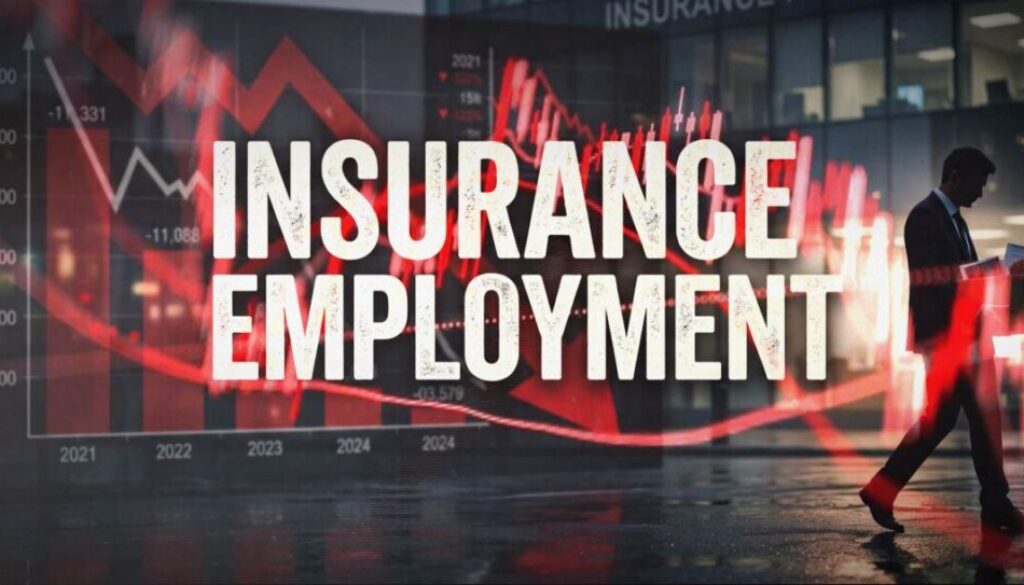
While overall U.S. employment remains resilient, insurance industry hiring is moving in the opposite direction.
It is a trend that is raising concerns in an industry anxious over both the growing use of artificial intelligence, and its own aging agent force.
The insurance industry lost 10,700 positions in May compared with the month prior, according to preliminary figures from the Department of Labor’s Bureau of Labor Statistics. That is on top of a decline of 9,100 positions in April and a 5,700 drop in March, the BLS reported.
June saw a further slight decline in insurance employment, but more alarmingly, a rise in unemployment to 2.7%, a high not seen since May 2025.
Insurance executives and analysts who study the industry are not concerned – yet.
“While it’s difficult to draw broad conclusions from a single month’s employment data, in our view, the industry remains well capitalized, and current workforce actions appear to be driven primarily by organizational restructuring and productivity gains rather than financial stress,” said Sridhar Manyem, senior director, industry research and analytics, AM Best.

Overall, the economy added 57,000 nonfarm payroll jobs in June, driven by gains in professional and business services, social assistance, and healthcare, while leisure and hospitality lost jobs. The national unemployment rate was 4.2% with 7.1 million unemployed people.
Growth of artificial intelligence
AI continues to transform the insurance industry by automating data-heavy workflows, personalizing coverage, and accelerating claims management. Traditionally reliant on historical math and manual reviews, insurers are using machine learning, computer vision and generative AI to shift from a reactive “damage control” model to a proactive, highly efficient ecosystem.
Employment numbers might be reflecting a greater reliance on AI.
“As the insurance sector recovers from several years of elevated catastrophe losses, insurers are placing greater emphasis on controlling expenses and improving operating efficiency,” Manyem said. “Recent commentary from insurance executives highlights an increasing focus on AI as a means of reducing expense ratios and enhancing productivity.”
AM Best’s recent survey of insurers on AI adoption supports this view, he added. While 37% of respondents indicated they expect to redeploy employees to higher-value work by using AI to automate routine, low-judgment tasks, only 9% anticipated a net reduction in head count.
Michel Léonard is chief economist and data scientist for the Insurance Information Institute. Insurance employment follows a cyclical trend, he said, as it is an industry that does not “over-hire or over-fire through economic cycles.”
AI is likely to be a net positive for agents and employment in the industry, Léonard added.
“Technology will keep agents competitive in a crowded market,” he explained. “It’s not just AI but a range of automation tools that speed up everything from policy acquisition and creation through claims processing. AI has proven most useful in sales and marketing—directly impacting agents’ bottom line.”
Rough spring
From March to April, life and health insurers shed 8,400 positions, the most of any industry sector, the BLS reported.
Insurance agencies and brokerages lost 2,200 jobs and pharmacy benefit managers and third-party administrators lost 400 jobs.
During the same time span, reinsurers added 800 jobs, claims adjusting added 600 jobs and direct property/casualty insurers added 200 jobs, the BLS said. Direct title and other direct insurance carriers added 100 positions.
For the insurance industry, total payrolls are reported each month on a seasonally adjusted basis, along with the current month’s nonfarm payrolls. Separately, data by industry segment — broken out by various insurance carriers and noncarrier categories — are available only on an unadjusted basis for the prior month.
Insurance employment was at an all-time peak in the first half of 2025 and has been shedding jobs slowly since, Léonard said.
“The decline began in the second half of 2025; early losses were small enough to attribute to attrition, but they accelerated by January of this year—signaling actual layoffs,” he explained. “Based on typical hiring cycles, we’ll likely keep shedding jobs into the rest of this year.”
The insurance industry features a steep structural pyramid, with roughly 1.4 million insurance professionals aged 55 or older, compared to just a fraction of that between the ages of 20 and 24, according to the recruiting firm, The Jonus Group. This translates to a 6-to-1 ratio of retirement-eligible veterans to young entrants.
But the industry will survive and has inherent strengths that appeal to younger people, Léonard said.
“Start with work-life balance. We’re the only part of the financial sector not retreating from remote work,” he said. “We pay well, and because we don’t over-hire or over-fire through job cycles, we pay more over time than the rest of finance or industries like tech.”
© Entire contents copyright 2026 by InsuranceNewsNet.com Inc. All rights reserved. No part of this article may be reprinted without the expressed written consent from InsuranceNewsNet.com.
The post Insurance industry employment shows disturbing declines appeared first on Insurance News | InsuranceNewsNet.