
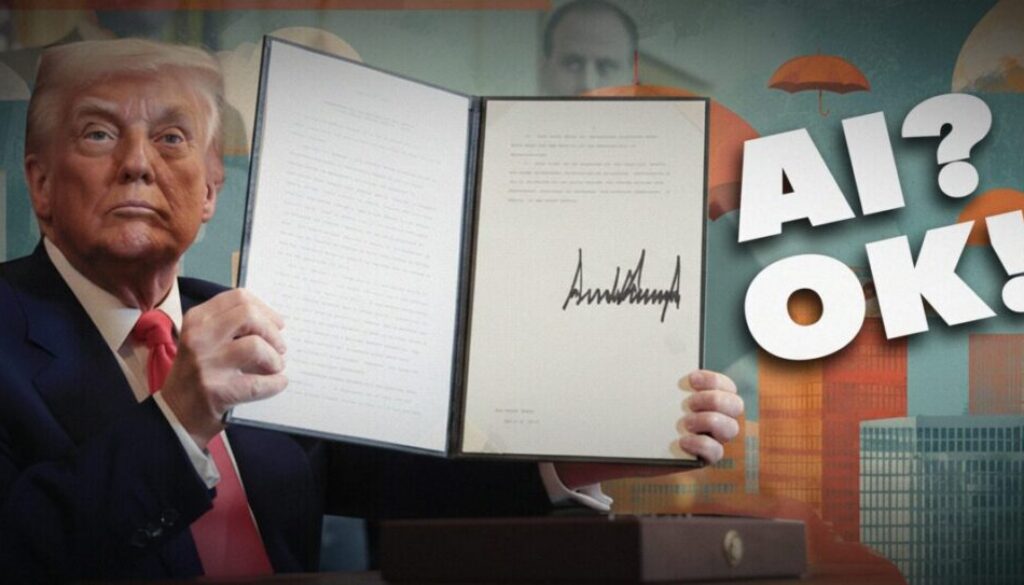
Trump executive order on AI creates more uncertainty for insurance landscape

The recent executive order proposing unified federal governance of AI laws has created more uncertainty for insurance companies, many of whom were already unsure about their own compliance requirements, according to legal experts across the U.S.
“Until the order is fully implemented and that enforceable federal regulatory scheme is in place, it’s going to create some uncertainty in how AI used by insurers is actually going to be regulated,” Karin Aldama, attorney and shareholder, Gallagher & Kennedy, said.
She suggested that insurers who operate in the U.S. are “basically going to have to work in a kind of dual-track environment where they still have to apply the state regulations while getting ready for complying with whatever is being implemented on the federal level.”
At the same time, Scott Kosnoff, partner, Faegre Drinker, cautioned insurers not to see the order as a “get-out-of-jail-free card” as that “would be short-sighted and lead to bad results.”
“Regardless of what’s happening politically, regardless of what’s happening with the state of the law, insurance companies have their own risk management to worry about. Insurance companies ought to remain vigilant with respect to their AI governance and risk management. Only by having a robust AI governance and risk management framework can they really mitigate all those different kinds of risks,” Kosnoff said.
Challenging state-issued AI frameworks
In December 2025, President Donald Trump signed an executive order on “Ensuring a National Policy Framework for Artificial Intelligence.” The order aims to establish a unified federal AI framework and a federal “AI Litigation Task Force” to target individual state AI laws.

“What the regulation is really trying to do is have some accountability and transparency and oversight of what the insurance companies are doing. So, if they’re using information that’s being pulled from an algorithm, or if they’re using information that’s being generated from machine learning, a human has to touch that file,” Gina Clausen Lozier, attorney and founding partner, Clausen Choquette, explained.
Aldama, while acknowledging the EO has created some confusion, said she believes it could be “a net positive” for the insurance industry if it manages to eliminate the “patchwork of state regulations of AI.”
She also noted that implementation could give national insurers a competitive advantage over smaller, regional companies because they “probably already have more systems in place that would allow them to change their compliance model more quickly.”
However, Paige Waters, partner, Troutman Pepper Locke, said regulators are concerned the executive order could be used to “try and prevent the states from enforcing their state laws that apply to AI and that are specific to insurance companies.”
“There’s a concern that the executive order is interfering with the states’ rights to regulate insurance in that space. In particular, they’re concerned because insurance companies have been using algorithms and predictive modeling for years and years that is currently regulated under state insurance laws,” Waters said.
Additionally, she said there is some concern that the interference could lead to litigation under the McCarran-Ferguson Act of 1945, which permits states to self-govern their respective insurance industries.
“I think is a bigger issue, maybe, that causes a lot of uncertainty within the insurance industry is that, if the executive order is interpreted or enforced in such a way that it would impinge on the state insurance commissioner’s right to regulate those insurance companies as they have been, there could be a litigation or court challenge, she said.
Keeping up with compliance
Despite the uncertainty, legal experts urged insurers to continue complying with state regulations and to ensure they observe AI framework guidelines, such as those issued by the NAIC Model Bulletin.
“I think they should continue to comply with the state regulations, but they should also first very carefully monitor what’s going on in terms of enforcement of the executive order by these federal agencies that are specifically asked to enforce it and they should monitor what the federal government does in terms of implementing the executive orders,” Aldama said.
For instance, she suggested insurers would be wise to pay attention to what kind of disputes may arise between states and the federal government over this AI executive order, and how both state insurance departments and the federal government may go about enforcing regulations.
“If there are proposed regulations, if there’s proposed legislation, they can then go ahead and get ready for complying with those new laws or regulations and basically updating or implementing systems and processes in their underwriting and claims handling that will comply with those regulations going forward,” Aldama said.
“I would think that the insurance companies would want to continue doing what they’re doing to comply because there may end up being litigation in the future with respect to whether or not the executive order is reverse preempted by the McCarran-Ferguson Act — and that litigation could take a long time to resolve,” Waters added.
Like Aldama, she also encouraged insurers to continue to comply with state insurance laws “until such a time as the insurance regulators are not enforcing those existing laws.”
Gallagher & Kennedy is an American law firm based in Arizona and founded in 1978.
Faegre Drinker Biddle & Reath LLP is a leading American law firm founded in 2020 through a merger between Faegre Baker Daniel and Drinker Biddle & Reath. Its headquarters is in Minnesota.
Troutman Pepper Locke is the U.S.-based law firm created from a 2025 merger between Troutman Pepper and Locke Lord. It now operates as an international firm with offices in the United States and London.
Clausen Choquette PLLC is a Florida-based law firm founded in 2023. Its primary area of focus is insurance coverage disputes.
© Entire contents copyright 2026 by InsuranceNewsNet.com Inc. All rights reserved. No part of this article may be reprinted without the expressed written consent from InsuranceNewsNet.com.
The post Trump executive order on AI creates more uncertainty for insurance landscape appeared first on Insurance News | InsuranceNewsNet.